Category Archives: UK

Mr. T

train

Mr. T is homeless. I first met him about six months ago, and since I usually see him about once a week I have got to know him a little. Thinking about American people all over the world getting ready to celebrate Thanksgiving, I thought I would introduce Mr. T to you and tell you a little about how he lives. Getting to know him and talking to him has made me thankful for the comforts and security I have.

I don’t know how long he’s been homeless, but it’s over ten years. I’d say he was in his fifties, but I’ve never asked his age. He often spends the day sitting in church (where I met him), listening to a small radio with earphones. Recently he’s been listening to the sumo tournament.

Several years ago I used to help out at another church in the diocese one Saturday a month, when there was a group who made food for homeless people in Shibuya. We used to spend several hours making pork soup and rice balls, or curry rice, and later in the evening another group took the meals to Shibuya Ward Office where a lot of homeless people slept. Several things have stayed with me since then; the care that was taken to cook a nutritious meal; the way we changed the menu according to the requests that were fed back to us, and the loving way everything was done. One of the group members told me that if a homeless person came to the church during the week, someone would cook a bowl of noodles and sit with him or her while they ate, to share some time together.

It was that last point that came back to me when I first met Mr. T, and his friend Mr. M. They were both in church, sitting quietly. We talked for a while, and it was then that I heard that Mr. T is from Hokkaido, and has no living relatives. Mr. M was from Chiba, and had a family, but never went back there. They told me that they’d been sticking together for over ten years, and that they slept in the entrance to a bank. In the winter they have sleeping bags to protect them from the elements, and in summer they have trouble with ants.

Mr. T seems to know all the places around Tokyo where he can get food, but to get to any of these places he has to walk. Depending on the day of the week there is food available at different locations, and Mr. T told me this evening that on Sundays there is a church which provides a meal. (It is common practice for Japanese Anglican churches to cook a meal after the service and for everyone to eat together, and it is this meal that Mr. T shares.) He also knows where he can go to be warm, so in addition to our church he often goes to a library, which has some kind of seating area downstairs where he can stay until it closes in the evening.

Last week I saw Mr. T for the first time in several weeks. He hadn’t been around and I was wondering where he and Mr. M were. In some distress he told me that he hadn’t seen Mr. M for over a month. They had often gone their separate ways during the day, but one evening Mr. M didn’t return to the bank entrance. Over the course of the month since then, Mr. T had gone in search of his friend; to the hospital which cares for homeless people; to the places where they had been together to receive food; to the park where Mr. M’s friend lives in a blue tarpaulin tent. Mr. M had spent a week over there once, helping his friend collect aluminium cans, crushing them and taking them somewhere to get money for the scrap metal. He tracked down the friend but no one had seen Mr. M.

Mr. T is desperately worried for his friend. He was worried that he had been involved in some kind of traffic accident, or that someone had beaten him up, but as time has gone on he has changed his mind. I had noticed that Mr. M had trouble walking, and Mr. T told me that he had a lot of sores on his legs, and he’s worried that his friend got some kind of infection. He used to put band-aids on his legs when he could, but if he couldn’t get any he used to use sticky tape. Mr. T is still waiting for his friend to come back, and that is how he reports the situation when he sees me: ‘He hasn’t come back yet.’

It is upsetting to listen to his distress, to his loneliness, and his feelings of despair that he has been unable to find and help his friend. Mr. M never seems far from his thoughts, and he often mentions him. A decade-plus friendship is a long one at any time, in any place, but on the street they have been each other’s support for so long, and now Mr. M is not there.

Life often whizzes by, there is so much we don’t see or don’t want to see every day. Getting to know Mr. T, to call him my friend, I have heard about how people live on the streets. It’s not easy to live with the information, and it makes me wonder at the resilience of the human body and spirit. So this Thanksgiving, although I’m not American, I shall appropriate it for my own. I am so very thankful to have a roof over my head, enough food to eat, enough money in the bank, for all the security that brings. Thankful too for all my friends, but I send up extra prayers for Mr. T and Mr. M, that Mr. M will find his way back and they can support each other again as they have done for years.

Missing the point

mice city

Japanese English has been a source of amusement for a very long time; I remember watching Clive James on British television in the 80s filling programmes with ill-advised product names or the sight of Japanese people competing in extreme and bizarre game shows. At the time Japan seemed a distant and completely alien land.

Now that I’ve lived here for over twenty years, I still see the silly stuff, the Collon chocolate, Pocari Sweat (sports drink), the reversed ‘l’s and ‘r’s, I still pull out my iPhone and take photos of particularly funny examples. I joke about it and say that I’m glad to see there’s a long way to go before English teachers are obsolete, but sometimes I don’t find it so funny. In the 21st century, when we can access information from all over the world within seconds, when people travel so much and cultures are intermingled so much more than in the past, I wonder about the magpie-like appropriation of any word or image that seems cool, and what the impact of that can be. I know that Japan is not alone in this; other countries in Asia do the same and it’s not hard to find websites dedicated to cataloguing it all. In the past week I have been thinking about the appropriation of strong words (specifically f***) and images that are sacred to one religion but an apparent accessory to other people.

Last year, I was looking online for Hello Kitty goods to send to a friend’s daughter, and a search took me to Japanese Amazon, where among all the kitchen utensils and other goods for the home I came across this, the Hello Kitty crucifix:

kitty crucifix

It was being marketed as a Hello Kitty ‘with a playful pose, in a sailor suit’. There was ‘plain type’ and ‘cross type’. It was expensive; ¥15,000, or about £100. I put it on Facebook at the time, finding it ridiculous in some kind of awful, eye-rolling, whatever-will-they-think-of-next kind of way. Last week I mentioned it to someone who wasn’t in Japan then, and I posted it again, and someone else saw it and called Sanrio (the company who markets Hello Kitty) and explained to them the power of the image they had appropriated. It turned out that the image had been licensed to another company, which had in turn commissioned a designer and these pieces were part of the resulting collection, though the cross was not part of the original agreement. Once they understood the juxtaposition of images and how some people may feel, Sanrio decided to ask for the item to be removed. They didn’t want Hello Kitty’s image to be tarnished.

It reminded me of a conversation a friend overheard in Yokohama some years ago. A young Japanese woman was choosing an accessory at a street stall, and the vendor asked her if she would like the cross ‘with or without the little man’. It’s funny, but it’s also toe-curlingly crass, depending on your point of view. I certainly don’t want to become one of those people Richard Dawkins loves to hold up for ridicule, but I do think that we should respect each other’s sacred images. The same goes for images of monarchy, which many people admire or revere, and, to some extent, national flags. It is not always the case that Japan treats its own sacred images in a way that implies respect. A trip to Kamakura will provide many opportunities to buy sweet bean paste-filled buns shaped like the Big Buddha, and even a kind of Buddha-shaped candy on a stick. I find these items slightly disturbing, but they seem popular with visitors to the area.

As well as the appropriation of sacred images, there has long been a casual use of so-called taboo words. At its mildest, it is the throwing about of ‘Oh my God!’, which even junior high school students will use. They copy it from TV comedians. At its strongest, it is merchandise with f*** all over it. At the school I used to work at I once saw a badge on a student’s pencil case with ‘f*** you’ on it (Hello Kitty again), and recently I have seen these two examples, both in Harajuku:

harajuku:11:25          harajuku:october

At first sight they probably seem comical, but are they? In Tokyo they may seem cool, but how would you feel if you were sitting next to someone on a train or a plane and they were wearing the shirt on the right? Are you sure you’d feel completely OK? Might you want to check if they understand what they’re broadcasting to the world?

Maybe I seem a bit squeaky, up on my hand legs yapping about something that a lot of people are not offended by in the least. Someone made the same point to me today, that f*** has become just another modifier, no different from ‘very’. I disagree with this, because in my experience people use the word with people they know. No one walks into a shop and uses that kind of language with the people working there. It’s not used in the media as just another word. It has power, and if it’s not used between people who know each other well, it’s fighting talk. It’s aggressive.

In 1992, a 16-year-old Japanese high school student called Yoshihiro Hattori went on an exchange trip to Baton Rouge, Louisiana. While he was there it was Hallowe’en, and with his homestay brother he dressed up in a costume and went to a party. Unfortunately they went to the wrong house, and the owner, spooked by strangers at his door, confronted the two teenagers with a gun, and shouted ‘freeze’. While his homestay brother understood, Hattori did not, and stepped forward, only to be shot at point-blank range and killed. There were two trials, one criminal and one civil, and the man who had shot him, Mr. Peairs was acquitted of the criminal charge but found liable in the civil trial. Since then, Mr. and Mrs. Hattori have campaigned for gun control and established a charity to enable American students to visit Japan.

I remember at the time, a lot of the Japanese people I worked with expressed shock at so much of what had happened; the use of a gun when all someone had done was knock on the wrong door; the acquittal of the man who had shot Hattori, and also, ‘Did you know what “freeze” meant?’ It seemed no-one did until this incident. He didn’t understand one word, stepped forward, and was shot. Under the law, Mr. Peairs was within his rights, but a high school student lost his life because he didn’t understand that one word.

So, is it important that a Japanese person who wants to wear an item of clothing with f*** on it understand the weight and power of that word? I think it is. If they understand it and still wear it, all fine and dandy. If anyone takes issue with them they’ll know why and will have worn it knowingly. The trouble is, I don’t think they do. It’s cool, it’s English, they vaguely know it’s not a good word, but I think that’s as far as it goes. All it takes is a misunderstanding over one word. It might start a fight, it might simply cause offence, it might spoil a vacation or create unfortunate stereotypes on both sides. Is it worth it?

It’s hot

Japan has four seasons. The rainy season is called a season, but does not impact the fact that Japan Has Four Seasons. A vehement shaking of the head.

In winter we remind each other as often as we can that it’s cold. Yes, it’s cold today. It was cold yesterday. Yes, it’s cold. Is your country this cold in winter? Well . . . probably a little colder, but then, we do have central heating, and that makes getting up in the morning a completely different experience.

The rainy season . . . it’s raining. Yes, I know, it’s the rainy season. Oh, the humidity has started. It’s humid today, isn’t it? Is your country humid? No, not like this. Ah, I thought so.

Now, I know that this is an important part of social interaction; we exchange non-threatening small talk about the weather, we agree, we feel better for having agreed and we go on our way.  But in all this, I am reminded of a scene from years and years ago on Fawlty Towers, when Sybil is badgering Basil about something, and he goes away muttering about Mastermind, and ‘Sybil Fawlty, subject, the bleeding obvious’. I do realise that if you’re not British I may have lost you with that last cultural reference, but anyway, moving swiftly on . . .

It’s hot. It’s humid. And while we may be taking part in the great social interaction and confirming widely-believed facts, part of me wants to say, yes, I know, and talking about it just draws our attention to it, surely? Except, I am feeling so wrung-out in the heat that I don’t have the energy to point that out.

It’s hot and humid, did I mention that?

Just as in winter, there are a number of nifty little ideas that Japanese people have used for many years to try to keep cool. Of course, most people have air conditioning at home, and certainly in shops and on trains the AC is quite ferocious, but there are other ways to try to keep cool too.

Wherever you go you will see people fanning themselves. Many people carry a folding fan in their bag or pocket, shops and other businesses often give out the non-folding type as promotional goods, and where neither are available people will use whatever they have to fan themselves; a book, a newspaper, a small towel or their hand. I first starting using a fan in summer when I lived in China, and remember taking several back to the UK because I liked the designs so much. Once I put one in my bag and on a particularly hot day pulled it out to use it and was met by incredulous looks from the people around me. I put it back in my bag and decided that was behaviour best confined to Asia. These days I have a fan in my school bag, one in my handbag, and at least one more at home. When my students pick up their textbook and employ it as a fan instead of the teaching tool it is meant to be, I don’t bat an eye. Go ahead, student! You keep cool any way you can. It’s hot and humid today, isn’t it?

While almost all of us enjoy sitting around in air-conditioned comfort at home, conventional wisdom dictates that sleeping with the AC on is A Very Bad Thing. No good will come of it, you will catch a cold and we shall all roll our eyes knowingly. The appropriate way to sleep on a hot summer night is to use an electric fan, which is surprisingly effective. There are cooling ice pillows (‘cooling’ seeming to be an understatement, what do you think is going to happen if you sleep with your head on a giant ice-cold gel pack?) and the excellently-named towelket. This is the hybrid offspring of a towel and a blanket (I’m sure you’d already figured that one out for yourself), which you use instead of a duvet in summer. I must admit that I don’t use all these things; I have a fan, but sometimes I wake up around 4:30 when the sun is coming up and switch to the AC. No good will come of it, I’m sure.

Summer in Japan also means insects. In most places you would think that that is obvious; hot weather bringing out all kinds of creepy crawlies which we dispose of in a variety of ways. If you’re thinking of mosquitoes and cockroaches, of course, we do the same in Japan. But there are other insects which are greeted with delight. Children go out looking for these mini beasts and carry them home triumphantly. Failing that, you can buy one in a department store, along with its own plastic box and the strange gel it likes to eat.

Last summer I was in Yamanashi on a school trip. On the last day, the Japanese teacher and I found some kind of stag beetle which we knew her young son would like. Between us we picked it up, carried it back to the cottage we were staying in, put it in a plastic box with a slice of Japanese pear, gerry-rigged a net used to catch organic waste in the sink over the box to contain the beetle but allow it to breathe, secured said net with dental floss, and at some point on the bus journey between Yamanashi and Tokyo even named it. It made it back to Tokyo, where my colleague continued to feed it and tend to its needs for several days. It expired before her son returned from his grandparents’ house, but not before she had put considerable energy into its care.

stagbeetleThe cicadas also are an important part of summer, their incredibly loud noise being part of the soundscape. In the last few days I have heard the first ones start up, and they will continue until some time in September.

cicadaAdding to the soundscape in my neighbourhood, of course, is my neighbour’s fondness for wind chimes. We have already had the great cacophony that is the full-on five-chime experience. Friends on Facebook have suggested a variety of remedies but since I do not possess Spiderman-like skills to scale the front of their house and make it up to the second floor to cut the things down, nor can I legally arm myself and take potshots at them (either the chimes or the neighbours) I can only close my windows, turn the AC on and try to ignore the sounds that I can still hear. How they find it relaxing I just don’t know.

The are other traditional Japanese responses to summer. I was in the supermarket today and saw a lot of people buying giant wedges of watermelon. A mobile phone shop was tempting people to stop and find out about some new service by offering free bottles of ramune, a traditional Japanese soda. I saw variety packs of small fireworks on sale in a local shop, which seems to me to be all wrong, since fireworks to a British person mean November 5th, Guy Fawkes, baked potatoes and bonfires, but I suppose to American and French people do mean summer celebrations. There will be giant firework dispays put on by different wards in Tokyo over the summer and people will buy these variety packs to have fun at home, which again creates alarm in me, a British person raised on public service announcements every autumn about the dangers of fireworks and why you should be very careful with them at home.

I have twice seen people at the station or on the train wearing yukata, lightweight summer kimono made of cotton. A few days ago I saw this teenage girl waiting for a train at my local station

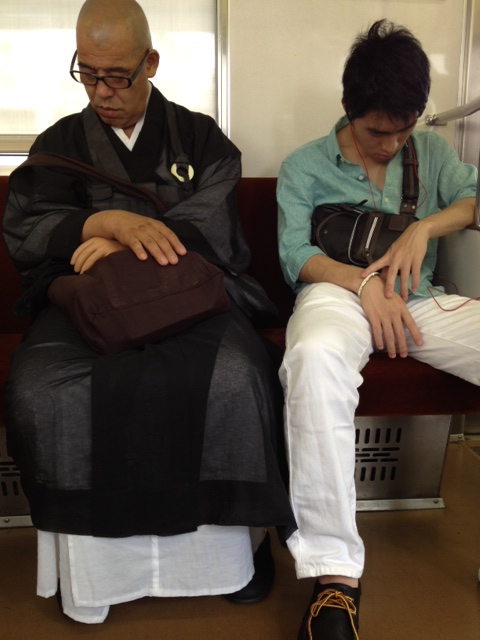
stationyukataand today I sat across from this man as he snoozed gently.

summergarb2Alternatively you could go for this all-pink ensemble I saw this morning:

summergarb1Here I sit in air-conditioned comfort (though I must say I am being ecologically responsible and have it set at 28 degrees). I feel a little hypocritical writing of the long, hot, humid summer stretching ahead of us, no relief until probably the end of September. I fly back to the UK on Tuesday. When I get back in August the heat, humidity, insects, will all still be here, but I will have a break from it all.

But have you heard about the British summer?  Sometimes it rains all the time and it isn’t very warm. Then again, it’s been too hot recently. But in my country? No, there’s no humidity, the insects are smaller and we certainly don’t keep them as pets.

I am looking forward to my summer holiday, but I shall miss Japan too; my life is here. It will be good to have a break, visit family and friends, re-charge my batteries, remind myself again just how lucky I am to be European and be able to hop around to other countries easily. But it will be good to come home again.

Wherever you are, I hope you have a wonderful summer.