Tag Archives: UK

Diligently, pedantically, reluctantly

New CrownWhen I first lived in China, I remember often meeting people who spoke impressively fluent English. On a train, walking down a street, at an ‘English Corner’ where people went to practise their English together, I met people who had studied for years, often on their own, who were keen to speak English and were eager to share opinions. I heard people speak with enthusiasm about Voice of America radio programmes, and was sometimes perplexed to be asked to speak ‘Special English’, which was VOA’s slowed-down version of the language for students of English. I remember on at least one occasion meeting someone who told me I was the first native speaker they had spoken to. And yet their English was very good; fluent, confident and accurate.

Then I came to Japan, and was perplexed to find how little English was spoken here, despite the many years of English classes in junior and senior high school which everyone receives. I began my English-teaching career in Japan at a language school, teaching little kids the name of every animal under the sun, a range of shouty toddler verbs (point! touch! run!) and not much grammatical glue to hold everything together. On the days when I wasn’t teaching little kids, I taught English to adults. They seemed to enjoy the classes but it was more a hobby, a social activity than an intellectual endeavour. It was fun, it was a lovely introduction to Japan, but it wasn’t like any approach to language study that I had ever encountered before.

After two years at the language school, my next job was at a private high school, and for the last twenty years that is the teaching environment I have found myself in. It is something I know well, but I also know the limitations and the frustrations. The challenges of teaching English in Japan have been written about many times, the apparently never-ending supply of weird and wacky English often posted online. I do it myself.  So it was with some sighing and eye-rolling that I approached an article the Japan Times published several weeks ago, titled, ‘English fluency hopes rest on an educational overhaul’. That old chestnut.

At the heart of the discussion are always the questions, why is the standard of English so low in general, when students spend so much time studying English? Why can’t Japanese people speak better English? And what’s up with all the weird stuff? People unfamiliar with the Japanese education system make the mistake of assuming that English is studied as a language, as a form of communication, that the goal in learning this language must be to be able to express yourself and communicate effectively. Those people are wrong.

The study of English in Japanese schools has always been primarily with one specific goal; to be able to pass entrance exams and enter university. All teaching methods, all textbooks are influenced by this one aim. All the private universities set their own exams, but for the national universities there is the Centre Test, a weekend-long marathon of tests administered around the middle of January and taken by all students hoping to enter a public university. The English component of the entrance exams, both private and the Centre Test, is heavily influenced by TOEFL and TOEIC, with lots of multiple choice questions. There is very little requirement to manipulate the language, and unless you are interviewing to major in English you probably won’t have to speak English either.

To do well in these exams, you need to study English grammar to a very high level, and learn a lot of very long words. In the teaching of this grammar, I have heard Japanese colleagues breaking down sentences into types, in a way I am unfamiliar with. It is rather like the classification of species. There are books of very long words, archaic and ridiculously formal, which must be memorised, but the lists are so random I wonder how anyone focuses. The idea of learning anything by lexical set is an alien concept.

This brings me to another aspect of the Japanese education system which emphasises a skill which I remember being actively discouraged from at school: memorisation. Of course, at school I had to study vocabulary, learn grammar rules, but memorisation, the rote learning of something simply to be able to regurgitate it exactly, that was not part of my education. It is a skill that Japanese students need to develop, and the amount of information they assimilate in this way is impressive. Somewhere in junior high school all students memorise all the countries in Africa. For a test. After the test they forget it again. The same goes for vocabulary tests. Memorise it, regurgitate it, next.

One method that Japanese English teachers use to encourage students to develop this skill is the memorising of chunks of English text. This has the unfortunate consequence of having the students focus on the memorising to the exclusion of all else, including pronunciation, which becomes garbled. But the student passes the ‘speaking test’ (which is really no such thing) and the idea that pronunciation is not so important is somehow planted in their minds. Another unintended consequence of this studying to such a high level, is that students are reluctant to speak because they feel unable to manipulate such complicated language, when the reality is, no one uses language at that level unless writing a formal letter or making a speech.

In all this, the teachers are trapped as much as the students. They teach from textbooks approved by the Ministry of Education, Culture, Sports, Science and Technology (文部科学省 Monbu-kagaku-shō), also known as MEXT, or Monka-shō, the Ministry formally known as Monbushō. While they seem to have a lot of time allotted for English classes, the amount of material they are expected to cover means that there is no time to review previous lessons, there is just one headlong dash through grammar and vocabulary at dizzying speed. It produces pressure and stress and a lot of people who really don’t like English. But it’s a means to an end, and that end is a university career that can affect the rest of your life.

Despite all this pressure, there are students who are enthusiastic about English. Travel and technology have made English more accessible, relevant and interesting. I have known many students who love English, who enjoy the challenge of communication, who somehow manage to juggle the demands of the academic study of English with their determination to speak, to write and to be themselves in another language.

Although the current state of English in Japan is largely due to the requirements of the educational system, I do wonder about these pronouncements that Japan is going to improve the overall level of English. I wonder for several reasons:

While the stated aim is to improve English ability, the approach can be haphazard. Having declared that children in elementary schools would begin learning English, elementary school teachers were required to start teaching – despite the fact that they are not trained teachers of English, often don’t speak English, and are just a step or two ahead of their students in what the lessons cover. More animals, the fruit and vegetables of the world and probably some verbs for good measure. Oh, and some greetings, such as ‘How are you?’ – ‘I’m fine, thank you.’ Everyone is always fine.

These regular articles about Japan needing to improve the level of English spoken by its people raise questions about Japan and where it sees itself on the international stage. Why do successive governments make these pronouncements? If they want to really change the system, they need to start with the university entrance exams. Nothing changes without them. Is English the language Japan needs? China is a near neighbour, as is South Korea. Why are those languages not taught more?  What is Japan going to do if it achieves its improved English? Just as in the UK, where very few public figures are ever heard speaking another language (though Tony Blair did like to pontificate in French sometimes), Japanese people don’t have many role models when it comes to just having a go and trying to communicate. I sometimes wonder if talking about it and tinkering with the system is just a way of making it seem like something is being done.

Shop til you drop

new year decoration1Christmas is a largely commercial affair in Japan. Of course, there are plenty of decorations put up, and that starts in November, but I don’t expect it is truly celebrated by anyone except the 1% of the population which is Christian. However, I would say that people enjoy it, in the same way they enjoy Valentine’s Day or Hallowe’en. Christmas Eve is the big date night of the year, and through some very clever marketing many Japanese people are convinced that a bucket of fried chicken from KFC and strawberry shortcake from the local convenience store are the perfect dinner on the 25th. Japanese people generally don’t exchange Christmas presents, and by the morning of the 26th all the decorations are gone, soon to be replaced with the traditional Shinto New Year decorations. For anyone newly-arrived in Japan, this sudden absence of all things Christmassy can be a shock, especially for someone feeling a little homesick and still getting used to the idea that December 25th is just another working day.

For Japanese people, the big celebration is New Year (正月). As shops shut down just before the end of the year, they put up New Year signs on their doors and kadomatsu (bamboo and pine decorations) on either side of the entrance.

new year shop entranceTraditionally, shops and other businesses didn’t open on the first three days (or sometimes more) of the new year, but every year more and more is open even on January 1st. As I did last year, I spent some time on New Year’s Day walking a 7 lucky gods pilgrimage, and was surprised at how much was open. Who wants to go to McDonald’s on New Year’s Day? The answer is, a surprising number of people. I enjoyed starting the year walking to shrines and temples, and this year walked with a friend, which was far more fun than doing it alone. She said her prayers at each stop, which made me slow down a little, and not just check off each one along the way and move on to the next one. It reminded me of what the route really was for. Last year I started earlier and so didn’t see so many people, but this year we waited in line several times.  Since I had already blogged about it I decided to do something different and posted on Facebook as I arrived at each temple or shrine, but if you would like to read about it, here is the link to last year’s post:

https://tokyopurplegirl.com/2013/01/04/starting-the-year-the-japanese-way/

Having spent January 1st in a very traditional way, I spent the afternoon of January 2nd in a way more recognisable to my students as a New Year tradition: the sales. January (or these days, end-of-December) sales are not a uniquely Japanese phenomenon. In many countries one of the first things people want to do after Christmas is go to the shops to return or exchange gifts and spend money or gift tokens they have been given.  As I already mentioned, Japanese people don’t exchange Christmas gifts, but anyone under twenty can look forward to receiving otoshidama (お年玉) at New Year. These are small envelopes containing money; gifts from parents, grandparents and other relatives. Many young people save all they are given, the reckless few spend it all, but often there is a compromise; they save some and they spend some.

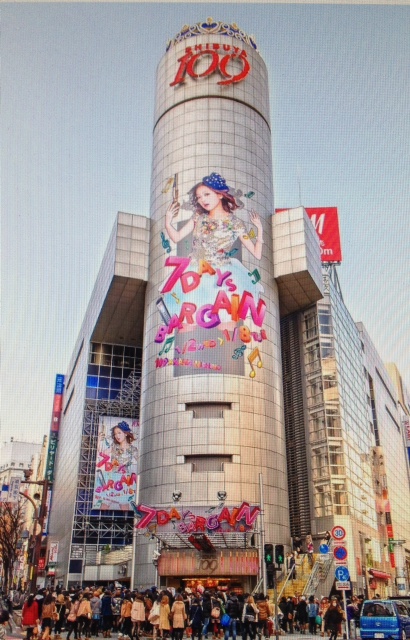
Shops re-open on January 2nd or a little later and are hoping that some of this New Year money is coming their way. For high school girls, there are two places which are a kind of mecca on any day of the year; Takeshita Dori (竹下通り) in Harajuku, and the 109 building in Shibuya. Yesterday I went shopping with someone visiting Tokyo, and we decided to go to the mothership, Shibuya 109. Before I went, someone told me they thought I was crazy even thinking about going there on January 2nd, but we were on a shopping mission, and nowhere else would do.

109 salesYesterday was the first day of the ‘7 days bargain’ and in the early afternoon it was absolutely packed. The noise levels were excruciating and there were personnel everywhere guiding people along, particularly near the escalators. There are eight floors, and each one is a collection of different shops. The escalators form the centre of the building, so the best way to see everything is to go up the escalator, then walk all the way round to see what you can find. Every shop was selling lucky bags or fukubukuro (福袋), sealed bags containing a variety of items. These bags are not cheap, most of the ones I saw yesterday started at ¥10,000, but you know that the value of the contents is more than that, you just don’t know what you’re going to get. At places like the Apple store you might get an iPad or a Macbook, and so some really determined people will camp out the night before (or maybe even longer) to ensure that they get their hands on such a bargain.

Back to the 109 building. Not only was every shop selling lucky bags, but there was at least one person, usually a young woman, shouting to attract attention. The crowds, the loud music, the screeching . . . you have no idea. We went up an escalator, round the floor, up the next escalator, round the next floor . . . we were on a mission for footwear, and so I can tell you that there are very few shops selling only shoes and boots. I think we found three. There was one on the first floor, one around the third or fourth floor, and one right at the top on the eighth.

It was an experience. The feeling of having all my senses bombarded was amazing, the only other time I have felt that was when someone took me into a pachinko parlour years ago, but this was even more extreme because of the crowds. Having successfully found something to buy, we headed straight down the escalators and emerged, gasping for air, into the afternoon sunshine. The Shibuya 109 building. Not for the faint-hearted.

年末年始

ginkgo

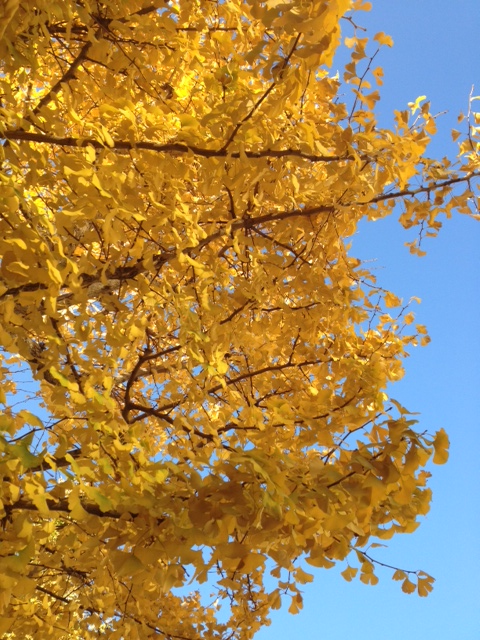
I love living in Tokyo, and after the heat of the summer I always look forward to the chill in the air as autumn arrives, to crisp days of blue skies and bright sunshine, to the vivid yellow ginkgo leaves and the flaming red maples.

autumn colours kamiyacho

But there is also something heavy in my heart, I suppose it’s the end of the year and I’m running on empty, but there’s still lots to do. It’s the season of 年末年始 or ‘nen matsu nen shi’, the end of one year and the beginning of the next.

It’s time to buy New Year cards and the special stamps to stick on them, to check with the people you usually send cards whether they have been bereaved this year, in which case, no card for them. It would be inappropriate to send them a ‘Happy New year’ greeting. If you have been bereaved in the past year, the onus is actually on you to send out a different kind of card to pre-empt the sending of New Year cards, reminding or informing people that you are in mourning and therefore not sending or receiving cards this year. I have found that people often just mention it in passing instead of sending the cards, but if you do send the cards then there are special postage stamps for them, too. I have bought my New Year cards, I have bought the special stamps (2014 being the year of the horse, so the stamps have little cartoon horses on them), and I have asked around to see who should not receive a card, so I’m all ready, I just have to write them all now.

new year stamps 2014

It’s also the bonenkai season (忘年会), time for a year-end party at work or with friends. Sometimes in English these social occasions get called Christmas party or dinner, but it’s dinner and/or drinks with friends, it’s the end of the year, it’s a bonenkai. Of course, this also means that there will be more passengers on the evening trains who have been drinking, and so there is a poster in Metro stations:

drunk on platform poster‘Ah! Dangerous! Take care on days when you have drunk too much alcohol,’ the poster warns. While it also mentions that walking and texting is dangerous, it helpfully informs us that 63.5% of people who fall off the platform have been drinking. This goofy poster is apparently part of a drive to have no ‘platform incidents’.

tokyo tower

Christmas is all over Tokyo. Well, Christmas trees, various assorted Santas and reindeer, and adverts for large buckets of chicken followed by strawberry shortcake, the perfect Christmas dinner, brought to you by KFC and 7-eleven. Really. This photo was taken at Tokyo Tower, you can just see the bottom of one of the legs. Think Eiffel Tower, painted red and white. There is an enormous Christmas tree under the tower, and a kind of winding maze of plastic illuminated reindeer, and when I walked past a couple of weeks ago there were a lot of high school girls wandering amongst the reindeer. An instant bucolic idyll, 21st-century Tokyo-style.  Just across the road was this display, angels heralding an office building.

shiba decorations

There are Christmas carols everywhere; my local shopping street has been playing them over the loudspeaker system for a while now. It’s rather odd, and always reminds me of The Prisoner, I feel I am being forced into Christmas early, and all the cutesy, jingly versions of songs and carols are quite surreal. Equally surreal will be the speed with which it all vanishes by December 26th to be replaced by New Year decorations.

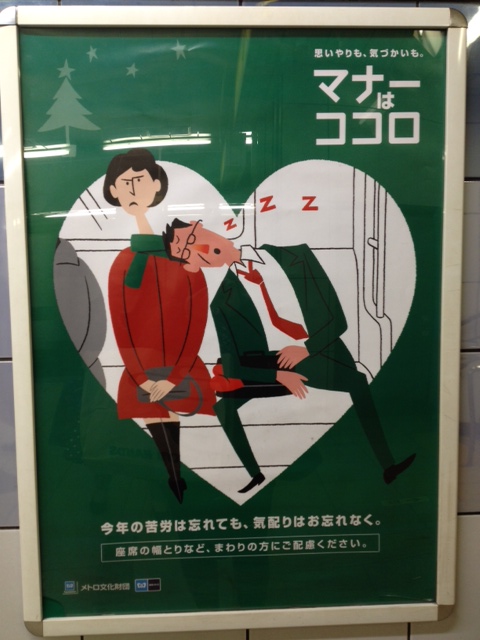
So boo, it’s almost the end of the year, and there is still so much to do. Time to finish up the term at school, get all the paperwork finished. Time to do Christmas shopping and write cards (and then New Year cards). Time to pack a suitcase and head back to the UK for a fortnight. So much to do before that. It’s enough to make you feel so exhausted you might fall asleep on someone on the train . . . but that would be inconsiderate, so the latest manner poster addresses it:

manner poster sleepingI do love living in Tokyo. In late autumn and winter the days are usually bright and sunny. I can see Mount Fuji from the train and I’m surrounded by the vibrant colours of Mother Nature’s last hurrah before she hunkers down to wait for spring. It’s good to spend time with friends celebrating the end of another year, it’s good to look forward to travelling. I just wish I had maybe a week or two more and a bit more energy.

Walking through Shibuya station yesterday evening I saw a Buddhist monk standing in the midst of all the commuters. People were rushing about, and in the middle of it all he stood praying and waiting for alms. Just standing there while rush hour carried on around him. Part of Shibuya station is pretty much a construction site at the moment, so there’s the added chaos that brings. He was just standing there, doing his thing, and I thought again, I do love Tokyo.

monk in shibuya