Category Archives: UK

Goodbye 2013

tokyo sunsetWhen people hear that I teach in Japan the most common reaction is some kind of assumption that all the students (a) work incredibly hard, (b) are unquestioningly obedient and well-behaved and (c) are quieter than proverbial church mice. My response to this is (a) their industry is the same as students in other countries, some work very hard, others do not and many are hindered by a lack of study skills, (b) they are certainly less of a challenge than the students my friends often teach in the UK but not unremittingly well-behaved, and (c) I work at a girls’ school, are you kidding?

As I have mentioned before, I think Japan is a country which is often portrayed in a stereotypical manner, and the appetite for wacky stories in foreign media is always there. What people say to me about my students is an extension of what many people believe to be an accurate portrayal of Japan and its people. It is frustrating to live here and watch with disbelief as yet another journalist files a stereotype-laden report, or takes one incident and extrapolates to imply a general truth. In over twenty years in Japan I have yet to meet a Japanese person who conforms to all those stereotypes, the quiet, obedient automaton.

Over ten years ago, a Swedish gospel singer came to visit the school, and as she sat on the stage waiting to begin a question-and-answer time after she had performed, she remarked that she could tell she was at a girls’ school because there was a noticeable level of chatter in the hall. Some things are not a surprise. What may come as a surprise to people who only know of Japan through cliché’d news items is the levels of noise in Japan sometimes. It is not always a land of zen-like tranquility, as anyone who has ever walked past a pachinko parlour can tell you. Politicians, right-wing sound trucks, recycle companies, roasted sweet potato vendors and purveyors of laundry poles are all capable of disturbing your wa (和), or harmony, as you relax at home, walk down your local street or take the train.

There is a word in Japanese which has a lot of different meanings, but Japanese language learners probably first encounter it as ‘noisy’: urusai (うるさい). My dictionary, however, offers all of the following as possible meanings: noisy, loud, annoying, troublesome, bothersome, persistent, fussy, particular and fastidious. I would say a person who is ‘urusai’ is a wa-disturber, and this year the leading lights of the Liberal Democratic Party (LDP) have been disturbing all kinds of wa. That their antics have not been more widely reported internationally is disappointing. I have heard Japanese friends express concern that this is how Japan slid towards militarism in the 1930s.

So, just to do my bit to draw attention to what Japanese politicians have been doing this year, here are their greatest hits:

* In May, Toru Hashimoto, the Mayor of Osaka declared that the ‘comfort women’ (women forced into prostitution by the Japanese military during WW2) were ‘necessary’. You can read about it here:

http://www.bbc.co.uk/news/world-asia-22519384

* In July, the Deputy PM, Taro Aso (also a brother-in-law of the Emperor) suggested that Japan could learn from how the Nazis pushed through unpopular legislation. You can read about it here:

http://www.bbc.co.uk/news/world-asia-23527300

He was referring to the current government’s desire to abolish Article 9, the part of the Japanese Constitution in which Japan denounces war and the means of war. Mr. Abe, the Prime Minister, has been getting more and more bellicose and would very much like to ditch Article 9 and arm Japan to the teeth. There is a hefty, so-called Self Defence Force, but Mr. Abe wants more. There have been groups all over Japan for a long time to protect Article 9, but this year it has come under serious threat.

* In September PM Abe reassured the IOC that Tokyo is and always will be safe from any danger that may come from the crippled nuclear power plant, Fukushima Daiichi. Following his statement and Tokyo being awarded the 2020 Olympics, the word ‘lie’ was used by parts of the media to refer to his comments. You can read about it here:

http://www.internationalpolicydigest.org/2013/09/25/did-japans-shinzo-abe-lie-to-get-the-olympics/

* Of course, the news that has rumbled on all year is the ongoing dispute between China and Japan (and Taiwan) regarding sovereignty over the group of tiny islands in the East China Sea, known in China as the Diaoyu Islands, and in Japan as the Senkaku Islands. In November China  declared an ‘air-defence zone’ over the islands, just the latest move in this very dangerous dance. You can read about it here:

http://www.bbc.co.uk/news/world-asia-25062525

* Finally, at the end of the year, Mr. Abe decided to make a visit to Yasukuni Shrine in his capacity as Prime Minister. While millions of Japan’s war dead are enshrined there, the souls of hundreds of war criminals, including a number of executed Class A war criminals are also enshrined, and it is this fact, and the apparent honouring or worship of these souls which so infuriates China and South Korea. You can read about it here:

http://www.bbc.co.uk/news/world-asia-25517205

So, Japanese politicians, I would say that you have been very ‘urusai’ this year, that this war-mongering is deeply troubling, that your lack of sensitivity (or deliberate disregard for other people’s and other countries’ feelings) is equally concerning. What are you doing to the country I love? This has not been a great year for Japan. With the exception of the successful Olympic bid, which did seem to boost spirits, 2013 has been a steady stream of worrying news from TEPCO and Fukushima Daiichi and the constant sound of rattling sabres.

So for 2014, my first prayer is for a concerted effort to really do something about the giant mess that is Fukushima Daiichi. The situation there is scary and there are many people who don’t know if, or when, they can ever go home. My second prayer is also related to the aftermath of the earthquake and tsunami; that the people who are still living in temporary housing almost three years later be re-housed in permanent new homes. My third prayer is for peace between the countries in East Asia, that we can all be much better neighbours than we have been in 2013.

12:30 blue skyFor myself, this has been a very mixed year, but I am ending the year feeling positive. I have travelled and seen friends, and in my life in Tokyo I have so many blessings. I have a job I love, friends and colleagues I am grateful for. In the last fifteen months I have found a new joy in writing this blog and been amazed that people read it. It’s a very humbling feeling. I am going into the new year with plenty to think about, lots of things I want to do.

Yesterday I was in Shibuya and saw a lot of people with suitcases, on their way somewhere to celebrate the New Year. When I went out to do some grocery shopping this afternoon I noticed how quiet everything was already. With the exception of the crowds in the supermarket there weren’t many people about. Tomorrow I am going to start the year the same way I did this year, walking a Seven Lucky Gods pilgrimage. The weather forecast is for another sunny day.

Goodbye, 2013. You’ve been an interesting year; not the best, but not the worst either. The neighbourhood has gone quiet, and I can hear the sound of the local volunteer fire corps on their yomawari (夜回り) or night patrol warning us of the perils of starting a fire. My new year cards are written and mailed, it’s time to curl up and relax.

new year postbox

Dreaming different dreams

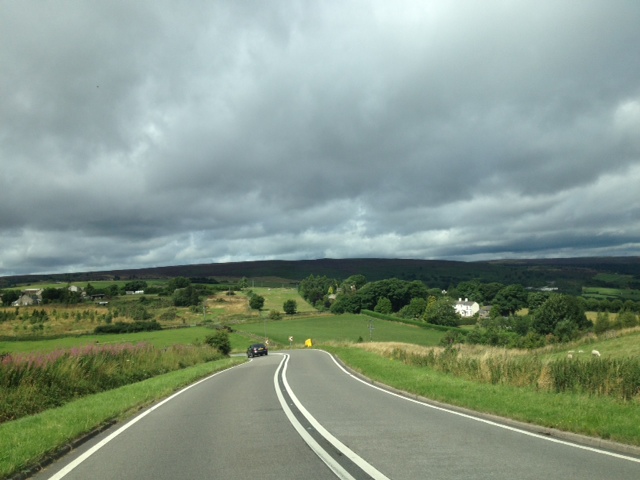
holmesfieldStudying Chinese at the University of Leeds in the mid-eighties, I found myself immersed in the wonderful world of Chinese propaganda. The dictionaries we used had ridiculously political example sentences, our textbooks exhorted us to ‘learn from Lei Feng’ and my vocabulary contained such gems as ‘running dog of the imperialists’ and ‘oppressing the masses’. After a year of intensive language study I spent a year in Shanghai, then returned to the UK for two more years of Modern Chinese Studies; the language, history, literature and politics of the modern Chinese state. One of the features of Chinese political manoeuvring was the frequent purges, falls from grace and miraculous political comebacks, and I was reminded of all this earlier this week, when I read about the purging in North Korea of Kim Jong-un’s uncle, Jang Song-thaek. Apparently he has been purged before, but this recent fall from grace seems to have been particularly public and theatrical. He has been accused of all manner of unspeakable behaviour:

“Jang pretended to uphold the party and leader but was engrossed in such factional acts as dreaming different dreams and involving himself in double-dealing behind the scene. Prompted by his politically-motivated ambition, he tried to increase his force and build his base for realising it by implanting those who had been punished for their serious wrongs in the past period into ranks of officials of departments of the party central committee and units under them. Affected by the capitalist way of living, Jang committed irregularities and corruption and led a dissolute and depraved life. By abusing his power, he was engrossed in irregularities and corruption, had improper relations with several women and was wined and dined at back parlours of deluxe restaurants. Ideologically sick and extremely idle and easy-going, he used drugs and squandered foreign currency at casinos while he was receiving medical treatment in a foreign country under the care of the party.”

He’s clearly been a busy and apparently very naughty man. I know it sounds completely over-the-top and ridiculous, but I also find it rather delicious. I feel quite nostalgic for my student days, when this kind of language was just another day in the classroom, just another example sentence in my dictionary. One phrase stood out though, three words, the title of this blog post, something that seemed to me to be a good thing, something to strive for, unless you live in the Orwellian state that is North Korea.

‘Dreaming different dreams’ – now why would that be wrong? As a teacher I am inspired by my students’ dreams, I find joy in the successes and achievements of my friends, I feel awe at the resilience and determination of the seemingly ordinary people I meet. In the days, weeks and months after the 3/11 earthquake in 2011 I was inspired by the resilience of the Japanese people, and in more than twenty years in Japan I have yet to meet the stereotypical Japanese person. There’s always something remarkable, something unusual, something unexpected.

My grandfather was born in the white house you can see in the distance on the right in the picture at the top of this post. He was the giant of our family, a man who didn’t have much education, but someone who worked hard, took care of the people he loved, faced down his fears if he could achieve something for his family, and became a managing director at a company in Sheffield. He died over twenty years ago, but my mother and I often talk about him, it doesn’t seem so long, and my godmother still remembers his presence and spirit. Though he was born one of three children in a poor family on the outskirts of Sheffield, he dreamt different dreams and achieved so much.

This month we have been doing speaking tests at school, and it is always an opportunity to talk to each girl individually and learn something of their achievements and dreams. Several years ago I spoke to one particularly quiet student who  told me that she regularly went to her local swimming pool to practise diving off a 10-metre-high diving board. Recently I have heard from a couple of students that they are going to study mechanical engineering. Many of them have travelled overseas, lived in other countries, are creative and have done a lot of volunteer work. A lot of them have been to Tohoku to work with survivors there. They are remarkable, their dreams often unusual and unexpected.

Growing up in Sheffield, studying French, Spanish and Latin at school, I realised that I loved and was good at learning languages and decided to do something completely new at university. A degree course in Chinese took me to Shanghai for a year; I travelled to Tibet during Spring Festival and saw amazing sights. I met Ralph Vaugh-Williams’ great niece and danced to the music of the ancient jazz band at the Peace Hotel on the Bund; decades earlier Noel Coward had written Private Lives there.

After graduation I returned to China, this time to Shenyang in Liaoning Province, in the north-east. I went there on the Trans-Siberian railway (in February!) and missed seeing the live pictures of Nelson Mandela’s release because I was somewhere near Lake Baikal at the time. In Shenyang I taught at a teachers’ college less than a year after the crackdown on the pro-democracy movement on June 4th 1989, made friends with Chinese students and personnel at the US consulate. One of my Chinese friends was merciless in her insistence that I practise my Chinese, and her persistence paid off. When we met she was a fearless 16-year-old, everyone’s fixer, she knew how to get things done. Today she is mother to three daughters, lives in Dubai and plays polo.

Is it a bad thing to ‘dream different dreams’? This is one of my favourite quotes:

“I have dreamt in my life, dreams that have stayed with me ever after, and changed my ideas; they have gone through and through me, like wine through water, and altered the color of my mind. ”  – Emily Brontë, Wuthering Heights

I love the quote, I love the image. I am me today because of dreams I’ve dreamt, dreams that were different, dreams that seemed quite outlandish or ridiculous to other people. I am me because of the places I’ve been, the people I’ve met, the books I’ve read, the cultures I’ve experienced. When I hear my students speak of their dreams I dream with them, excited about the journeys they will take in their lives. It is a giant cosmic gift, this ability to dream, to imagine, to dare to go places and do things. To look at look at the world around us every day and just feel a tingling, fizzing sense of joy, to find inspiration in anything and everything, it is fate, it is serendipity, it is God’s plan, it is the universe unfolding as it should, it is whatever you feel it is. We all dream different dreams, and that is the most amazing thing of all.

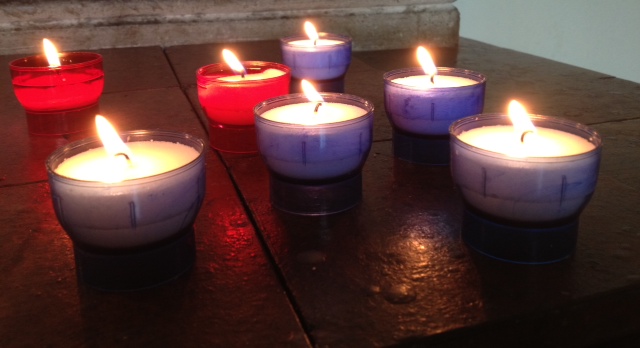
julian shrine candles

年末年始

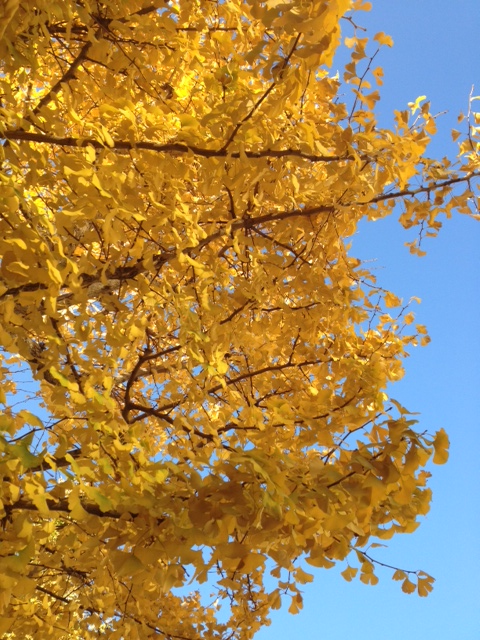
ginkgo

I love living in Tokyo, and after the heat of the summer I always look forward to the chill in the air as autumn arrives, to crisp days of blue skies and bright sunshine, to the vivid yellow ginkgo leaves and the flaming red maples.

autumn colours kamiyacho

But there is also something heavy in my heart, I suppose it’s the end of the year and I’m running on empty, but there’s still lots to do. It’s the season of 年末年始 or ‘nen matsu nen shi’, the end of one year and the beginning of the next.

It’s time to buy New Year cards and the special stamps to stick on them, to check with the people you usually send cards whether they have been bereaved this year, in which case, no card for them. It would be inappropriate to send them a ‘Happy New year’ greeting. If you have been bereaved in the past year, the onus is actually on you to send out a different kind of card to pre-empt the sending of New Year cards, reminding or informing people that you are in mourning and therefore not sending or receiving cards this year. I have found that people often just mention it in passing instead of sending the cards, but if you do send the cards then there are special postage stamps for them, too. I have bought my New Year cards, I have bought the special stamps (2014 being the year of the horse, so the stamps have little cartoon horses on them), and I have asked around to see who should not receive a card, so I’m all ready, I just have to write them all now.

new year stamps 2014

It’s also the bonenkai season (忘年会), time for a year-end party at work or with friends. Sometimes in English these social occasions get called Christmas party or dinner, but it’s dinner and/or drinks with friends, it’s the end of the year, it’s a bonenkai. Of course, this also means that there will be more passengers on the evening trains who have been drinking, and so there is a poster in Metro stations:

drunk on platform poster‘Ah! Dangerous! Take care on days when you have drunk too much alcohol,’ the poster warns. While it also mentions that walking and texting is dangerous, it helpfully informs us that 63.5% of people who fall off the platform have been drinking. This goofy poster is apparently part of a drive to have no ‘platform incidents’.

tokyo tower

Christmas is all over Tokyo. Well, Christmas trees, various assorted Santas and reindeer, and adverts for large buckets of chicken followed by strawberry shortcake, the perfect Christmas dinner, brought to you by KFC and 7-eleven. Really. This photo was taken at Tokyo Tower, you can just see the bottom of one of the legs. Think Eiffel Tower, painted red and white. There is an enormous Christmas tree under the tower, and a kind of winding maze of plastic illuminated reindeer, and when I walked past a couple of weeks ago there were a lot of high school girls wandering amongst the reindeer. An instant bucolic idyll, 21st-century Tokyo-style.  Just across the road was this display, angels heralding an office building.

shiba decorations

There are Christmas carols everywhere; my local shopping street has been playing them over the loudspeaker system for a while now. It’s rather odd, and always reminds me of The Prisoner, I feel I am being forced into Christmas early, and all the cutesy, jingly versions of songs and carols are quite surreal. Equally surreal will be the speed with which it all vanishes by December 26th to be replaced by New Year decorations.

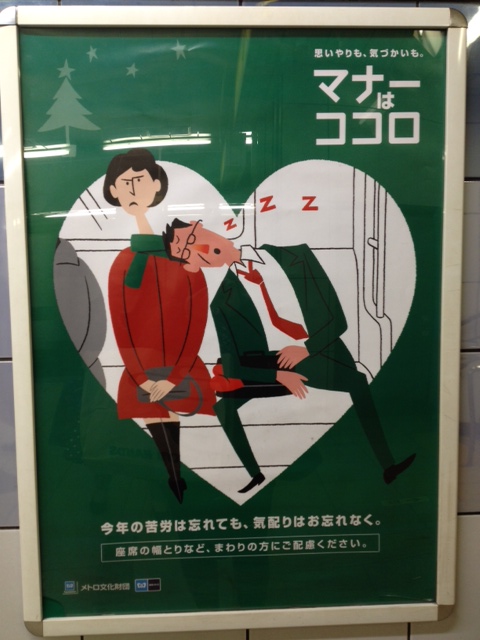
So boo, it’s almost the end of the year, and there is still so much to do. Time to finish up the term at school, get all the paperwork finished. Time to do Christmas shopping and write cards (and then New Year cards). Time to pack a suitcase and head back to the UK for a fortnight. So much to do before that. It’s enough to make you feel so exhausted you might fall asleep on someone on the train . . . but that would be inconsiderate, so the latest manner poster addresses it:

manner poster sleepingI do love living in Tokyo. In late autumn and winter the days are usually bright and sunny. I can see Mount Fuji from the train and I’m surrounded by the vibrant colours of Mother Nature’s last hurrah before she hunkers down to wait for spring. It’s good to spend time with friends celebrating the end of another year, it’s good to look forward to travelling. I just wish I had maybe a week or two more and a bit more energy.

Walking through Shibuya station yesterday evening I saw a Buddhist monk standing in the midst of all the commuters. People were rushing about, and in the middle of it all he stood praying and waiting for alms. Just standing there while rush hour carried on around him. Part of Shibuya station is pretty much a construction site at the moment, so there’s the added chaos that brings. He was just standing there, doing his thing, and I thought again, I do love Tokyo.

monk in shibuya