
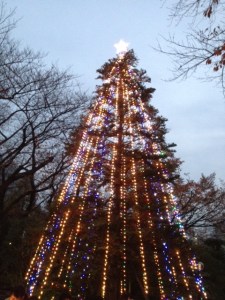
 I work at an Anglican school, and every year, on the Friday afternoon before Advent begins, we have a short service for the lighting of the tree. We don’t get a special Christmas tree every year, instead we decorate the large conifer at the top of the drive. The chaplain leads us in prayer, we sing a carol (It Came Upon A Midnight Clear, sung to the American tune which always reminds me of Home On The Range), the tree is lit and the choir sings Joy To The World. We stand at the top of the drive, effectively blocking the way out of school and so swelling our numbers with any girl on her way home but lacking the gall to wriggle through the throng. Before the short service we are issued with candles inside paper cups, this year handed out with warnings to hold the cup carefully; it seems the hole in the bottom was a little big and to hold only the candle would be to invite danger. I had never noticed before, but after the tree was lit I saw a member of the office staff inside the tree; I imagine he had been tasked to flick the switch and was then stranded but illuminated, wondering where he should go.
So the tree is lit, and while all the shops seem to think it’s Christmas already, I am looking forward to Advent. School has been particularly hectic recently; we are in the middle of speaking tests, so I suppose that’s not surprising. Squeaking through the tests with my little froggy croak has entertained the girls no end but has been quite a frustrating experience, and I shall be glad to finish everything and stop talking for a while. We have two more weeks of work; tests, grades, preparation, and then I fly back to the UK for Christmas there.
Today I have been struck by sounds; this occurred to me when I heard the 5 o’clock chimes, which are broadcast every day, as far as I know all over Japan. I have always believed that it is a traditional way to alert schoolchildren to the time and that they should be on their way home. I think every ward in Tokyo plays a different melody. I have also read, however, that it is a way for the ward office to check that the emergency announcement system is working (in case of earthquakes etc.), but I prefer to think it’s a service to Japan’s children. I sat here listening to the chimes and thought about other sounds that I had heard today.
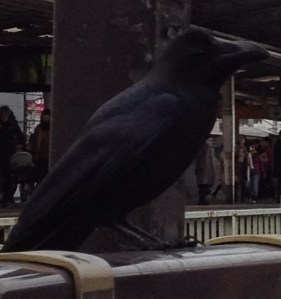
Earlier this afternoon, when I was on my way home, I saw a crow sitting on a railing near the station. Japanese crows are very big, not easily intimidated, the kind of bird to sit calmly on a railing only a metre or so away from you, regarding you with darkly glittering beady eyes and occasionally cawing in a raucous and territorial way. This one let me take its picture, it’s quite dark but I shall include it anyway:
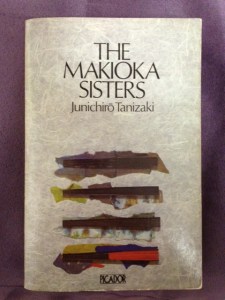
 My day started with a quiet service at church, space and peace after a long week. On the way home I stopped at a 2nd-hand bookshop and bought a copy of The Makioka Sisters by Junichiro Tanizaki. It is the same edition I read when I was at secondary school. I re-read it when I was living in Japan in the early nineties, and I have been feeling the urge to read it again. To find a worn copy with the same cover I remember from 1987 almost makes me feel like I have found my own copy again! I shall look forward to reading it over the holidays and blog about it later.
 The end of another weekend. I have spent time with good friends, in person and on the phone. Despite my inclination to sleep away part of this afternoon, the universe conspired against me and instead I had a long chat with an old friend, a much better way to spend the time. I feel connected and my batteries are re-charged; I’m ready for another week.
 tokyopurplegirl