Tag Archives: Shibuya

Hello, kitties!

hapineko postcardYesterday I visited a cat cafe. I had heard plenty about such establishments and had never been to one, but I was doing one of my favourite things, showing someone around Tokyo, and thought that a cat cafe would make an interesting addition to our itinerary.

I had thought that this was a particularly Japanese idea, but apparently not; the first cat cafe was in Taiwan, but received so many Japanese visitors that it didn’t take long for someone to realise the potential and the first one opened in Japan in 2004. There are many in Tokyo and it isn’t hard to find one, all it takes is a search for ‘cat cafe’ and the area of Tokyo you are interested in.

While the idea of a cafe where you can have a cup of tea or coffee surrounded by cats may seem like a bizarre concept to people outside Japan, here it makes some kind of sense, particularly in a crowded city like Tokyo. People often live in very small apartments, many have tatami matting on the floors, and pets are just not allowed. Any cat could make short work of tatami; it’s probably excellent as a kind of horizontal scratching post. So people may find themselves living in a small space, alone, and wishing they could have a pet but unable to do so because of the terms of their lease. In such circumstances, the idea of going to a cafe, sitting for an hour or two with cats around the place, being able to pet them or just watch them play or sleep, is something that appeals to the lonely and petless of Tokyo.

The cafe we visited is called ‘Hapineko’ (ハピ猫), or Happy Cat. It’s in Shibuya and easy to find. Walk from Shibuya Crossing up to the 109 Building and take the left fork. Continue up the road on the same side as the 109 Building for a couple of minutes, and you will see a flashing orange sign on the wall saying ‘cat cafe’ and ‘猫カフェ’. Turn right into the building, walk down a short corridor, turn right up the stairs then take the elevator to the third floor. When you come out of the elevator, go up another short flight of stairs, then turn left and you’re at Hapineko.

white catOf course, since there are a number of cats in the cafe itself, there is a kind of entrance where you choose how long you want to stay, what you want to drink, and are shown information about how to behave in the cafe. This cafe lets you stay for multiples of thirty minutes, from half an hour up to whatever you’re prepared to pay for, and we decided to stay for the shortest time. Half an hour with one drink costs ¥1,050, so it could soon become quite expensive if you wanted to hang around for a couple of hours, or if you developed a serious cat cafe-visiting habit.

Having chosen the drinks and paid, and said we understood what to do (and not to do) we removed our shoes and entered the cafe. Before you get anywhere near the cats you are required to put on slippers, store all your bags behind the counter and wash your hands then use an alcohol rub to make sure you are no kind of biohazard to the cats. Finally you can sit down and look at and pet the cats.

4 catsThere were probably about ten cats around the cafe, some awake and some asleep. Several were wearing pink or white collars, and we had been instructed that we must not touch these cats. No explanation was given, and at least one of these untouchable cats was wide awake and wandering around, apparently quite friendly and curious, but it was Not To Be Touched. Some people were sitting at one end of the room, just watching the cats, but we stroked some of the cats near us and they responded in true feline style by not caring a jot about us. Some were sleeping and didn’t even wake up.

sleeping catsWhile it is all right to pick up the cats and hold them on your lap, we were unclear about how you could achieve this. While it was clear that of course you should not pick up a cat by its front legs and swing it about (illustrated on a poster on the wall with a black cross over it), it was also unacceptable to pick up a cat from a height, which seemed to imply that you couldn’t perform such a manoeuvre standing up. This would indicate that really it’s better to wait for the cats to come to you, which probably requires patience and paying for more that thirty minutes.

When our thirty minutes were up, we collected our bags and were given a souvenir postcard of the cafe. It was an interesting experience, and I can see if you loved cats and were unable to keep one as a pet, being able to visit such a cafe might be quite relaxing. As a novelty for someone visiting Japan I’d recommend it (so if you come to visit me, beware!), and if you find yourself living in a tiny cramped apartment in Tokyo it might just be a good place to unwind one afternoon.

hapineko

Have stereotypes, will travel

Up unreasonably early again this morning, and on the train to church I read the newspaper. The Daily Yomiuri has a section on Sunday of articles from The Times, so I usually flick through to that section first. Imagine my annoyance when the first headline that caught my eye was ‘The shattering of my dream to be the perfect expat wife in Tokyo’. It was subtitled, ‘Lucy Alexander discovered how hard it is for a Westerner to slip into Japanese society’.

I read the offending article, rolling my eyes and wondering why The Times was publishing this clichéd stuff, imagining that it was indeed by a self-styled ‘expat wife’, uprooted from her career in the UK to move to Japan for her husband’s work. It certainly read like that. It reminded me of some of the articles published as eyewitness accounts after the earthquake in March 2011, my personal favourite being this one: http://www.telegraph.co.uk/expat/expatlife/8426171/A-tearful-sayonara-to-quake-hit-Japan.html .

But no. At home this evening I Googled her, only to find that she’s a professional journalist working in Tokyo, which makes me wonder, why is she misrepresenting herself simply as ‘expat wife’, and why is she peddling such stereotypes? She states early on in her article that, ‘I had moved from London to Tokyo six months previously, towing two toddlers and leaving behind family, friends and work . . . I was now an illiterate trailing spouse in a foreign country.’ Oh, where to start? First of all, I am offended on behalf of all the wonderful, strong women I know who have moved here because of their spouse’s work and channeled their considerable talents and energies into their lives here. Secondly, Ms. Alexander has not left behind her work, she is still very much working as a journalist in Tokyo, so why pretend otherwise?

The article makes a number of claims, all of which I disagree with. The first of her ridiculous statements is, ‘your average British or American woman in Tokyo does find that she is a public novelty.’ I have no idea what she or her acquaintances are doing but no, I do not find that and have not heard anyone I know say that either. I can only imagine that she is behaving in some way that Tokyoites find odd, maybe being extremely loud in public (I have been told to pipe down on a bus when I was chatting at a normal volume with a friend), or alternatively approaching people and speaking English instead of trying to speak Japanese. I don’t think any foreign resident in Tokyo feels like a public novelty; maybe in some rural areas that is the case, I don’t know. Tokyo is a huge international city and no one is going to react with much interest to the sight of one of us going about our day.

Next, there is a reference to ‘the salaryman reading porn manga, . . . the teenager wearing a Victorian crinoline and surgical facemask, with black tears pencilled onto her cheeks’. Right then, to unpack all these images; yes, there is some disturbing porn in manga (graphic novel) form, as I am sure there is in many other countries. The difference in Japan appears to be two-fold; it is readily available and not sold shrink-wrapped, and it is also acceptable to read this kind of material in public, or at least it is possible to read it without anyone taking you to task. I wonder what would happen to the hapless commuter on the Tube with the same taste in reading matter. While it is certainly objectionable to realise that the man standing or sitting next to you is engrossed in such manga, you are far more likely to see him reading one of the so-called sports newspapers, which are published in two different editions. There is one for home delivery, containing sport and tabloid fodder, then there is the other edition, sold at station kiosks, convenience stores etc. which contains the same plus photographs of young women in a state of undress and spread-eagled in a fashion their gynaecologists would be familiar with. These newspapers are the same size as broadsheets, so someone reading one may choose to fold the pages to make them more manageable, in which case you could find yourself suddenly staring at these very unpleasant and quite explicit photos.

The teenager in Victorian crinoline . . . I think she is confused, I don’t think I have ever seen anyone actually wearing such a contraption, but what is quite a common sight, particularly around Harajuku and Shibuya, is young women dressed in a style known as ‘Gothic Lolita’. There are many different sub-genres of Lolita fashion, which has its roots in anime culture but also owes something to Marie Antoinette, apparently. It has nothing to do with the Nabokov novel of the same name. Someone dressed as a Gothic Lolita would wear mainly black and white frilly or lacy elaborate costumes, accessorised with vampy make-up and the odd crucifix or two. No crinoline, though, but plenty of corsetry. The facemask, again, is a common sight here, people wear them to protect themselves from cold and ‘flu germs in the winter (or to protect other people if they are already ill), or to try to block out tree pollen in the spring.

Now I come to what I found the most irritating of all the article’s claims; ‘it is true that Japanese and Westerners rarely socialise because of the profound differences between the Japanese and English languages, the rigid and highly complex set of social rules by which most Japanese govern their behaviour and Western laziness and arrogance.’ Where to start . . . may I ask, if you are reading this in a country where you are a citizen, how many foreign residents do you know? How many friends do you have who are not the same nationality as you? Should someone move from their country to yours and live next door to you, would you befriend them immediately and invite them into your home? Would you push through all the cultural differences at breakneck speed and know them well in a matter of a few short months? No? What this article is ascribing to a yawning chasm of cultural differences so wide no one can get over it, seems to me to be nothing more than human nature. British and Japanese people have some similarities and I would say that one is a general reticence and reluctance to be instantly friendly with people. It’s something pointed out as a foible of American behaviour, this alarmingly speedy commitment to friendship. Japanese people don’t invite each other into their homes much, do you know how small Japanese homes can be? It is far more usual to meet somewhere and go out for a meal, shopping or coffee.

From there, the article degenerates into references to expat wives who ‘may not be actually psychotic but many do develop mild neuroses’, and tales of sordid goings-on at hostess bars. I’m sure it’s an entertaining read for someone not familiar with Japan, but like the BBC articles and reports I’ve taken issue with before, it just isn’t true. The anecdotes in this article are just that, but the journalist has extrapolated a whole culture after being here only a few short months.

I’ve called Japan home for twenty years, and I have a lot of wonderful Japanese friends, but in many cases I haven’t been to their homes, nor have they been to mine. It’s an issue of space, not an unwillingness to socialise. When I first arrived in Japan it did take a while to get to know people, and when I moved to a new job it took time to make friends, but the friendships I have made are with some of the most generous, caring and wonderful people I have ever met. I believe a Japanese person moving to the UK and living my experiences in reverse would have had a similar experience. Sometimes it takes time, but it’s worth it.

Goodbye 2012

Tokyo is slowly shutting down as the New Year approaches. To a visitor the city might look crowded, but the trains and buses are not crowded at all and instead of the usual rush and bustle there is a more relaxed, but still purposeful sense of activity. People are stocking up for the next few days, since everything except convenience stores will be closed tomorrow. As with many other countries, every year more and more shops open earlier and earlier so by January 2nd there are plenty of places to go if you fancy a bit of retail therapy.

Many years ago, everything closed for 3 days, and everyone spent time with family. In the days leading up to New Year, everyone pitched in to do a big clean and special New Year dishes collectively called ‘osechi’, each with a symbolic meaning, were prepared. These days, at least according to the Japanese people I know, people do clean but not necessarily with the fervour of yesteryear, and the osechi dishes are eaten on the 1st but not in vast amounts. They are very expensive if bought in a department store, and hugely time-consuming to make at home.

My version of Japanese New Year is quiet, but since I have only just come back from the UK the whole Giant Cleaning binge is lost on me. I haven’t the energy or the time; I prefer to do my spring-cleaning in spring when I can open the windows and let fresh air in without freezing.

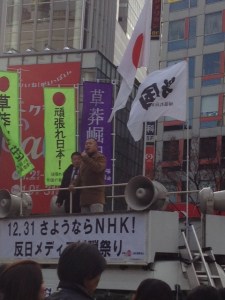
Despite the general air of winding down, I was surprised to find a noisy demonstration taking place outside Shibuya station. There were dozens of people standing there with large Japanese flags and placards, listening to a very angry man on top of a campaign truck who was very exercised about NHK, the national broadcaster. His comments and the placards were the same; that NHK is anti-Japan, anti-emperor and pandering to China. In the course of his screeching, Mr. Angry announced that later in the afternoon they would all march to the central offices of NHK and demonstrate there. Not everyone was winding down, it seemed; he was very clearly winding up himself and everyone listening.

NHK protest

Continuing the general theme of angry shouty Japanese men, Japan has wrapped up the year electing the right-wing LDP (Liberal Democratic Party), is still embroiled in territorial disputes with China and South Korea, and the economy is looking shaky. The new government seems keener on keeping nuclear power than the rest of the population, but just to reassure us all Prime Minister Abe has appointed a Minister for Nuclear Emergency Preparedness, Nobuteru Ishihara,  spawn of former Tokyo governor Ishihara. So that’s all right then.

Today’s Daily Yomiuri newspaper has a centre spread of the Top Ten Domestic news stories of 2012. They are:

1. Yamanaka wins Nobel Prize for iPS research                                                                                 2. Tokyo Skytree opens                                                                                                                      3. Uchimura, Yoshida shine in London Olympics                                                                              4. LDP wins Lower House poll, retakes power                                                                                  5. Japan-China ties sour over Senkakus                                                                                           6. Annular solar eclipse seen from Tohoku to Kyushu                                                                       7. Ceiling panels fall in Sasago Tunnel, killing 9                                                                                8. Giants win 1st championship in 3 years                                                                                        9. Final Aum fugitives arrested                                                                                                        10. Multiple murder mystery linked to Miyoko Sumida

I wonder how many of those made the news outside Japan; I think I can only say with confidence that four did. Plenty to blog about then.

I bought some sushi and came home, posting my New Year greeting cards on the way back. To be delivered tomorrow they should have been posted by the 25th, but I didn’t get my act together before I flew back to the UK and so they will be delivered a couple of days later. I also bought a bag of mikan, or mandarin oranges, and plan to do very little for the next few days.

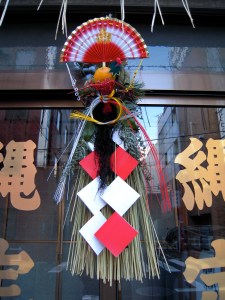
As I walked home I saw a lot of traditional New Year Shinto decorations on windows, gates or doors

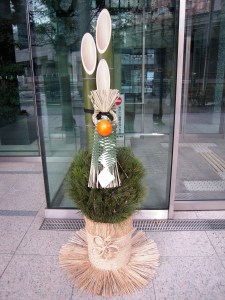
DSCN0521and some businesses already had the pine and bamboo decoration called ‘kadomatsu’ (門松) outside

DSCN0524The sky was pink as the sun set and the neighbourhood seemed very quiet.

Dec 31stAs I write this, I can hear the neighbourhood volunteers walking down the road, warning us to be careful about fire hazards in our homes. On TV I have just watched an advert for dietary supplements for women, made from pig placenta, and the BBC, bravely ignoring all of the above news stories, have once again broadcast one of their ‘Japanese obsession’ stories, this time about a supposed obsession with cuteness and a school where you can train to be a mascot and spend your days inside a large furry suit. Sigh. As I have written this I have made a mental note to write more about a lot of things I’ve mentioned, but for now this is my snapshot of the end of the year.

Goodbye 2012. You were an improvement on 2011, but you could have been better. Let’s see what 2013 brings us. Now I am snuggled up at home, it’s time for sushi!