
 At church yesterday a fairly new Tokyoite asked us about winter here. How cold does it get? About freezing, we answered. And snow? Oh no, we assured him, we hardly ever have snow, and when we do it doesn’t settle.
Twenty-four hours later, and . . . oops. According to an app on my phone the temperature is 1 degree celsius but ‘feels like -7’, and according to a tweet from the UK ambassador we had 3 inches of snow in 3 hours. The transport system is affected; many flights out of Haneda are cancelled and some train lines have stopped. I watched the snow get deeper and deeper this morning and by early afternoon I decided to go for a walk, since we very rarely have a day like this.
Fortunately, today is a national holiday; the second Monday in January is Coming of Age Day (成人の日). It used to be that the ceremony was only for people who had already reached their twentieth birthday, but in recent years it has changed and is now for anyone who has turned or will turn twenty between April 2nd last year and April 1st this year. Also, it used to be held on January 15th and so was a moveable feast, but in 2000 the Happy Monday system was introduced and four National holidays, including Coming of Age Day, were moved from a specific date to a specific Monday every year, to create some long weekends, and therefore, happy Mondays. So, good for most of us, it means we don’t have to work today, not so good for all those new adults who have been trying to get somewhere to mark the occasion. Traditionally, they are invited to the city or ward office to listen to speeches and be congratulated, and then go out with friends or family to celebrate. Men can wear hakama (袴), formal kimono for men (and very smart, too) but can also wear a western suit. This photo, of a bride and groom, actually, will give you an idea, since the groom is wearing a hakama.
 Women traditionally wear a long-sleeved kimono called a furisode (振袖). They are beautiful and elaborate; usually hairdressers advertise months ahead of time that they’re taking bookings for women to go in early on Coming of Age Day to be dressed in a kimono and have their hair and make-up done. The kimono is accessorised with zori (草履) sandals. Beautiful but not easy to walk in if you’re not used to it, which most young women aren’t, and today must have presented even more of a challenge. I saw these two young women walking gingerly along the road near the station:
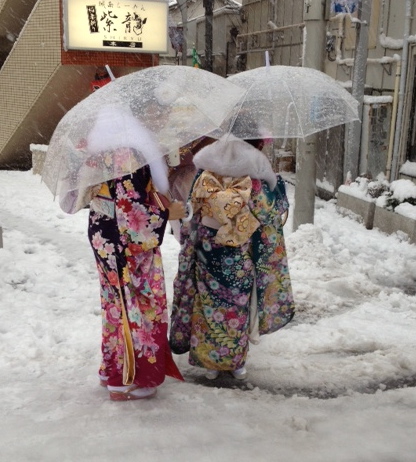 Apart from them, I saw quite a lot of people out in the snow. There were some university students chasing each other along the road having a snowball fight, and a primary-school-age boy came out of his apartment building dragging a bright red sled with a look of absolute delight and chattering excitedly to himself about the wonders before him.
I walked across the railway tracks and saw a train waiting at the station. A little further along I saw the two young women in kimono. Just a few metres past them, the pachinko parlour was open, and one of the employees was hosing down the road in front. I saw a lot of shops and other businesses trying to clear the bit of road in front of their building, but usually with a shovel or a broom. This was the only place using water to blast the snow away, but with temperatures hovering around freezing it seemed like a recipe for disaster.
I walked along the shopping street as far as the supermarket. By then my toes were cold, so I was happy to find it was warm and toasty inside. I didn’t really need to go shopping today, but I bought some mikan (tangerines) and extra vegetables and tofu to add to my green curry this evening. On the way back it seemed like the snowflakes were a little smaller and wetter, but there was an icy wind making everything feel colder. Back across the railway tracks, and the same train was still at the station, with announcements being made that one of the lines had stopped, at least.
I trudged back up the hill to my apartment and was relieved to get home, have a mug of hot chocolate and settle down to write this post. I thought I could hear that the snow had turned to rain, but when I went outside to check I found it’s still snowing but it’s quite wet now. Tomorrow we’re all back at work, we’ll have to see if everything freezes overnight and what effect that will have, but for now I’m going to stay warm and snug at home.





 tokyopurplegirl