Tag Archives: China

June 4th all over again

June 4th 1989. I wonder if you remember where you were that day. I do. It had been a strange few weeks leading up to that day.

On April 15th I had been part of a small group going from Sheffield to London to welcome a delegation from Anshan in Liaoning province in north east China. Anshan and Sheffield were twin towns (sister cities), linked because of the steel and coal industries. I remember waiting outside Sheffield Town Hall with the woman in charge of the city’s relations with its twin towns, listening to sirens. A lot of sirens. We waited for the car that would take us down to London, and we asked ourselves what on earth could be going on that there would be so many emergency vehicles on the roads.

As we made our way down to London we listened to news reports and gradually learnt what had happened at Hillsborough. How so many Liverpool fans had been crushed to death in the stadium. By the time we reached the hotel that evening it was clear that something heartbreakingly awful had happened. There were 96 fatalities and the relatives of those victims are still waiting for the whole story and justice.

The next day we met the six people who had come from Anshan, and then began several days of surreal sight-seeing. I was the interpreter, but I was told not to mention what had happened in Sheffield. We were to tell them just before we got back to the city. We went to Windsor, to Eton, to Stratford-upon-Avon, and in the evenings we watched the news and carried the sadness in our hearts.

As we approached Sheffield I told them what had happened, and explained that the city was in mourning. We hoped they would understand if people seemed subdued. They listened carefully, then asked, ‘How many people did you say had died?’ ’96.’ ‘And they were from another city?’ ‘Yes, they were from Liverpool.’ ‘Only 96 people and not from your city, then . . . ‘ I remember feeling amazed at the cold-hearted calculations.

There was something else on the TV news every day. Something else we were not to mention to our Chinese guests. There were protestors in Tian An Men Square. They had gone there first to mourn the death of Hu Yaobang, but like the protestors in Turkey today, it quickly became a bigger movement. The students wanted democracy, and they besieged the Great Hall of the People for weeks. President Gorbachev visited China during that time and could not enter the building from the square because of the on-going protests. It went on for about seven weeks, and then on the night of June 3rd/4th they sent in the soldiers. How many died that night? No one knows. Hundreds? Thousands?

I remember going to church on the 4th and someone asking me what was going on, they thought I might understand it since I had lived in China. After all the optimism, after the occupation of the square for weeks without violence it had all become terrifyingly bloody. I had no answers.

One year later I was living in China, teaching at Shenyang Teachers’ College. It was a strange time. I had gone back as much to improve my Chinese as to teach English, but with the exception of 2 brave young women it was difficult to find Chinese people willing to be friends. I asked if I could get a daily newspaper; I was told it would be arranged, but it never was. My students doubled as the censors of my mail, they knew my news from home before I did and weren’t afraid to tell me so. But quietly, I heard the personal stories of some of the students. How they had all been told to go home in May, do not go to Beijing, do not pass go, but really many had gone, showing their student cards and getting a free ride to the capital.

There had been a small pro-democracy movement on campus; the leader was being held somewhere. He was released and one day appeared at the back of my class, back against the wall, nervous, suffering from eczema, too anxious to talk much. I heard that he had been held for months in solitary confinement, with nothing to do. He had been alone with his thoughts for a very long time. As suddenly as he appeared, he was gone again. I don’t know where he went. He might have dropped out, just gone home to his parents. I hope that’s what happened.

On June 4th 1990, all classes were cancelled. Apparently not because it was the first anniversary of what had happened in Tian An Men Square, but on some pretext. It was a strange, quiet day, made stranger by the entire phone system in the college not working. The people who had told me they had been to Beijing the previous year had no desire to try the experiment again. One day around that time I was in the centre of Shenyang with one of my brave friends and an elderly lady noticed she was of college age and started speaking to her about the events of the previous spring. ‘Are you students going to do something again this year?’ she asked. Of course not.

June 4th, 1989. The Chinese students’ version of the Statue of Liberty held her flame aloft with both hands, I remember a student being interviewed and explaining that she needed more strength to hold up democracy in China. I remember watching the student leaders, in pyjamas, attached to drips, on hunger strike but meeting with the politicians, arguing their case. Their lost cause. In the years since, the leaders from those days have left China, a new generation of activists has emerged. So far, Chinese democracy has not. The economy is booming, but the gap between the urban rich and the poor in the countryside grows wider and wider. The Chinese people I know are hard-working, friendly, truly, you could not find a more loyal friend. They know who they are, they know the history they come from, and they are proud people. Like the people of other countries, they are not well-served by their leaders in many ways.

Twenty-four years ago there was a generation of students who were optimistic, or maybe naive, or both. They thought their leaders would listen, but in the end they didn’t.

incense smokeJune 4th 1989. Never forget what happened that day.
Goodbye 2012

Tokyo is slowly shutting down as the New Year approaches. To a visitor the city might look crowded, but the trains and buses are not crowded at all and instead of the usual rush and bustle there is a more relaxed, but still purposeful sense of activity. People are stocking up for the next few days, since everything except convenience stores will be closed tomorrow. As with many other countries, every year more and more shops open earlier and earlier so by January 2nd there are plenty of places to go if you fancy a bit of retail therapy.

Many years ago, everything closed for 3 days, and everyone spent time with family. In the days leading up to New Year, everyone pitched in to do a big clean and special New Year dishes collectively called ‘osechi’, each with a symbolic meaning, were prepared. These days, at least according to the Japanese people I know, people do clean but not necessarily with the fervour of yesteryear, and the osechi dishes are eaten on the 1st but not in vast amounts. They are very expensive if bought in a department store, and hugely time-consuming to make at home.

My version of Japanese New Year is quiet, but since I have only just come back from the UK the whole Giant Cleaning binge is lost on me. I haven’t the energy or the time; I prefer to do my spring-cleaning in spring when I can open the windows and let fresh air in without freezing.

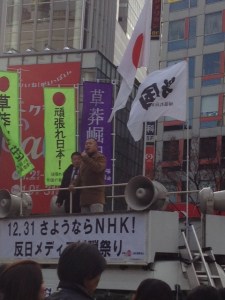
Despite the general air of winding down, I was surprised to find a noisy demonstration taking place outside Shibuya station. There were dozens of people standing there with large Japanese flags and placards, listening to a very angry man on top of a campaign truck who was very exercised about NHK, the national broadcaster. His comments and the placards were the same; that NHK is anti-Japan, anti-emperor and pandering to China. In the course of his screeching, Mr. Angry announced that later in the afternoon they would all march to the central offices of NHK and demonstrate there. Not everyone was winding down, it seemed; he was very clearly winding up himself and everyone listening.

NHK protest

Continuing the general theme of angry shouty Japanese men, Japan has wrapped up the year electing the right-wing LDP (Liberal Democratic Party), is still embroiled in territorial disputes with China and South Korea, and the economy is looking shaky. The new government seems keener on keeping nuclear power than the rest of the population, but just to reassure us all Prime Minister Abe has appointed a Minister for Nuclear Emergency Preparedness, Nobuteru Ishihara,  spawn of former Tokyo governor Ishihara. So that’s all right then.

Today’s Daily Yomiuri newspaper has a centre spread of the Top Ten Domestic news stories of 2012. They are:

1. Yamanaka wins Nobel Prize for iPS research                                                                                 2. Tokyo Skytree opens                                                                                                                      3. Uchimura, Yoshida shine in London Olympics                                                                              4. LDP wins Lower House poll, retakes power                                                                                  5. Japan-China ties sour over Senkakus                                                                                           6. Annular solar eclipse seen from Tohoku to Kyushu                                                                       7. Ceiling panels fall in Sasago Tunnel, killing 9                                                                                8. Giants win 1st championship in 3 years                                                                                        9. Final Aum fugitives arrested                                                                                                        10. Multiple murder mystery linked to Miyoko Sumida

I wonder how many of those made the news outside Japan; I think I can only say with confidence that four did. Plenty to blog about then.

I bought some sushi and came home, posting my New Year greeting cards on the way back. To be delivered tomorrow they should have been posted by the 25th, but I didn’t get my act together before I flew back to the UK and so they will be delivered a couple of days later. I also bought a bag of mikan, or mandarin oranges, and plan to do very little for the next few days.

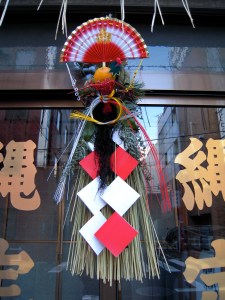
As I walked home I saw a lot of traditional New Year Shinto decorations on windows, gates or doors

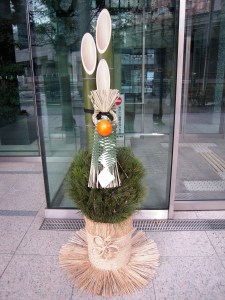
DSCN0521and some businesses already had the pine and bamboo decoration called ‘kadomatsu’ (門松) outside

DSCN0524The sky was pink as the sun set and the neighbourhood seemed very quiet.

Dec 31stAs I write this, I can hear the neighbourhood volunteers walking down the road, warning us to be careful about fire hazards in our homes. On TV I have just watched an advert for dietary supplements for women, made from pig placenta, and the BBC, bravely ignoring all of the above news stories, have once again broadcast one of their ‘Japanese obsession’ stories, this time about a supposed obsession with cuteness and a school where you can train to be a mascot and spend your days inside a large furry suit. Sigh. As I have written this I have made a mental note to write more about a lot of things I’ve mentioned, but for now this is my snapshot of the end of the year.

Goodbye 2012. You were an improvement on 2011, but you could have been better. Let’s see what 2013 brings us. Now I am snuggled up at home, it’s time for sushi!

Senkaku? Diaoyu?

Japan and China (and Taiwan) are currently embroiled in a dispute about who has sovereignty over a group of very small islands in the East China Sea, called the Senkaku Islands in Japanese, known to Chinese speakers as the Diaoyu Islands. You can read about the background to this dispute on the BBC website, http://www.bbc.co.uk/news/world-asia-pacific-11341139 but this morning there was an article in the Daily Yomiuri about the so-called ‘propaganda war’ both China and Japan are engaged in, domestically, but also internationally. Since someone had told me earlier in the week that Japanese TV news reports refer to the islands as the ‘Senkaku Islands, Okinawa Prefecture’ this caught my attention.

The current situation is the same as it has been for weeks now; Japan has Coast Guard boats patrolling around the islands, while China and Taiwan continue to send their Coast Guards to the disputed area to play cat-and-mouse with their Japanese counterparts. Taiwan has also sent fishing boats and there have also been boatloads of Taiwanese journalists. On at least one day the Coast Guards have circled each other firing their water canon at each other. Vaguely ridiculous, but since it could escalate very easily so it’s also rather scary. The newspaper article refers to this daily tension as ‘steady’.

Clearly, since I am in Tokyo and reading about this in a Japanese newspaper, the language (and editorial content) favours the Japanese view. So I can read this morning that ‘Beijing began a large-scale propaganda campaign to win over international opinion’ while ‘Foreign Ministry officials have been explaining Japan’s position on the Senkaku issue to officials at various embassies in Tokyo and in the overseas media’ including an appearance on American TV by a Japanese diplomat. At government level, the latest salvo is the refusal of the Chinese Finance Minister, the People’s Bank of China governor and other assorted Chinese bank representatives to attend the annual IMF and World Bank meetings being held in Tokyo. Since the Chinese economy is the 2nd largest in the world this is clearly going to affect what can be discussed there and sounds like A Big Deal.

However, this is the same kind of thing we have been hearing for a while, so I was more interested in the information in the article about the ramifications of the row. According to the article, sales of Japanese-made cars in China in September dropped 40.8% compared to last year, and 66,000 seats on Japan-China routes booked for the period from September to November have been canceled. Roughly two thirds of those seats were on ANA flights, one third were on JAL. These numbers don’t just mean flights canceled; each one is a tourist who won’t come to Japan and  spend money here. It’s also 66,000 lost opportunities for Chinese and Japanese people to connect with each other, and that is a real pity. Clearly, this could have serious implications for Japan; you can see the official statistics on the Japan Tourism Marketing site, http://www.tourism.jp/english/statistics/inbound.php. According to these numbers, that 66,000 will make a big dent in the number of tourists coming from China. Elsewhere I have found that Japan has the third largest travel and tourist economy in the world, and that was badly impacted last year after the earthquake, tsunami and nuclear emergency at Fukushima Dai-ichi, when tourism was down 28% from 2010.

Serious stuff. Although it only takes one hothead with a gun on one of those Coast Guard boats (from any of the 3 countries) to make this so much more serious, while those boats are bobbing about firing water canon at each other the economic ramifications are already serious. I don’t have the solution, but I hope this grandstanding, whether it is ‘propaganda’ or ‘explaining a stance’ somehow becomes diplomatic negotiations to resolve this stand-off.