Saudade?

Arisugawa rain 1

It’s the rainy season, and so I am feeling a kind of soggy melancholy , an absence of something, a general dissatisfaction. I am wondering if this is saudade, apparently a longing for someone or something that is absent.

It’s almost the end of term, an in-between time. I’ve finished teaching but still have some paperwork to do. I fly back to the UK next week, but I have a lot to do here before I leave. Sometimes I feel that I’m right here, I am completely where I stand, all of me is concentrated on being where I am, and then other times I feel that I’m not quite here, but not quite there either. Nothing completely connects. This is one of those times.

In London ten years ago, on July 7th, 2005, four suicide bombers blew themselves up and in doing so killed fifty-two people and injured over seven hundred.

In Tokyo ten years ago I spent a lovely evening with a friend; a production of The Producers and dinner, I’m not sure which came first, but I think maybe the theatre. I remember I came home feeling content and relaxed, looking forward to flying back to the UK a few days later.

At home there was a message from my father on the answerphone; a little cryptic, he sounded urgent and was trying to reassure me. He told me that my brother was OK, I wasn’t to worry, everything was fine. Having no idea what he was talking about, I called my parents back, and turned on the TV. I remember perching on the edge of the sofa, rolling my eyes, listening to the phone start to ring, and then absorbing the news from the muted BBC. Four bombs had exploded on London transport.

My father’s message made sense then. My brother was living in London at the time, commuting to work on the Tube every morning. He had been at his desk by the time of the attacks. When I checked my e-mail he had already been in touch, reassuring me that he was OK; he was at work, everything was fine. He had called our parents to tell them the same thing, just as I would do in March 2011; e-mail to him, phone call to parents; it’s OK, it was a big earthquake, the tsunami did terrible damage, but in Tokyo we’re all right. Rattled, but all right.

And then I remember having that feeling, an emotional dislocation, knowing that my country was going through something huge and I was thousands of miles away. I have spent most of my adult life in Asia, and most of that time in Japan. I have consciously removed myself from my own country, I have chosen this distance. And yet, sometimes I feel very far from the mothership. Or rather, I feel the distance between.

I spend my life being British in another country. I routinely get asked random questions about the Royal Family, the correct way to make a cup of tea, the best places to go in London and how to get around, what I think of Stephen Fry, Jeremy Clarkson, the monkey named after the baby princess. Sometimes I have an answer, sometimes I have nothing. Sometimes I want to say, don’t ask me anything after 1990. I don’t know how much a stamp costs, I’ve never watched Downton Abbey, I’m a bit of a fraud, really.

Then I go back to the UK and get all the questions in reverse about Japan. What’s the weather like, is everyone really polite, are your students silent all the time, have you ever been on one of those really crowded trains I’ve seen on YouTube? It all feels like an exercise in time and space, all designed to make me aware of the the distance in between.

I remember calling my brother a few hours later that evening. The trains and buses weren’t running yet, but he was happy to stay at work and go home later. When he had moved to London and decided where to live he had told me that he could walk home from work if he needed to, it was only four or five miles. I asked him to walk home that evening; he declined, and said he’d take a bus or the Tube later. When he got home he sent me another e-mail to tell me he had taken the bus and had seen Tony Blair getting out of a helicopter at Chelsea Barracks. I was annoyed with him for taking a risk, as I saw it, but a month later I was in London myself, and several Tube lines stopped running. I felt almost irrationally determined to get back to his flat on the Tube and when I emerged at Clapham Common I felt victorious in the most deliciously bloody-minded way. Then I understood why he hadn’t walked home that evening.


Just another day in Tokyo

2 windchimes

May 4th is みどりの日, or Greenery Day. A national holiday, and part of the string of holidays known as Golden Week. We have been having some wonderful weather recently, the kind of warm, sunny days that in the UK in August would make a lovely summer. I spent most of today at home, with all my windows open. I did some laundry, I did a bit of spring cleaning, I just enjoyed being at home.

My neighbours were also at home. Now, I have lived here for almost seventeen years. I have never had a conversation with any of the people who live next door, but I am aware of their activities daily. Their house is quite large, and an elderly woman lives on the first floor. The second floor is home to a couple in their fifties, I assume either the son or daughter of the elderly resident downstairs, and their spouse. They are sometimes visited by their son, a man in his late twenties, and his toddler daughter. I am wary of these people, because they can be inconsiderate to the point of being quite antisocial. I have seen the visiting son try to start a fight with a delivery man. Last year they arranged to have their house encased in scaffolding during Golden Week, with no notice given to neighbours. Someone regularly plays the piano after 11pm and uses a hairdryer at 2am.

One of the things that makes the second floor residents happy is wind chimes. The photo at the top of this blogpost is their balcony, and you can see that they are well into the swing of summery behaviour already; plenty of greenery, a mosquito-repelling implement and wind chimes. Wind chimes plural. Because if one wind chime can enhance a summer’s day with a pleasant, occasional tinkly sound, then surely more wind chimes will enhance the day even more. Last week the first wind chime was up. Today I opened my windows and noticed that there was clearly more than one. I went outside to conduct surveillance and confirmed that we had moved into plural wind chime territory. Today was not really wind chime-friendly weather, since it was quite a blustery day, and so the soundtrack of my day was the frantic jangling of these wind chimes. Their record is five, we clearly have a way to go yet.

Tokyo Tower May 4th

I went out to church this evening; Monday evening means Evening Prayer and our newly-founded Rosary Group. A calm after the wind chime storm. Tokyo Tower was lit up on Greenery Day in every colour except green, and as usual there were a lot of people taking photos. Because it was a national holiday there seemed to be more tourists than usual and the area was quite busy.

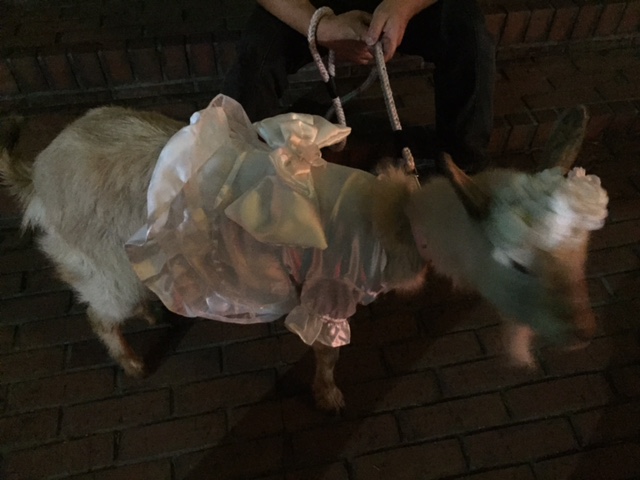
As I was closing the church doors I noticed a couple sitting on the steps in front of the building, and someone approached them and asked if she could take a photo of their dog. Wondering what was so special about this dog that made it photo-worthy I looked closer and realised it wasn’t a dog at all. It was a goat. Even better, it was a goat wearing a wedding dress. I went back into church to tell my friend. ‘Come outside, there’s a goat wearing a wedding dress.’

I, too, asked if I could take a photo. I also asked if I could pet the goat and was told it was safe to stroke her back, but to not try to touch her head (which was adorned with a rather fetching floral arrangement perched between her horns). I learnt that the goat’s name was Mero. So I patted Mero’s bum, and took a photo:

Mero the goat

Neighbours with an over-fondness for wind chimes, Tokyo Tower lit up in a rainbow of colours, and a goat called Mero, wearing a wedding dress. Thank you, Tokyo. Especially for the goat.

Looking back but never going home

plum blossom blue sky

The weather hasn’t been great recently, but this morning brought vivid blues skies and bright sunshine. The plum tree outside my window is blooming, it was a wonderful way to start the day. It’s almost the end of the school year, so classes are over but there’s still a lot of paperwork to do and the day stretched ahead, a normal end-of-term day.

Except today is not just another day, it’s March 11th, the 4th anniversary of the M9 earthquake and massive tsunami that devastated Tohoku, killed thousands, left thousands more missing and hundreds of thousands displaced and homeless. Today I have been thinking a lot about that day four years ago, about all the stresses that followed, but all the small comforts too.

The earthquake struck at 2:46pm. I was at home, with my ladies’ reading group. It started as a moderate quake and just kept getting bigger. The ladies put cushions on their heads and I stood watching everything swaying and rattling. It went on and on, and the ground seemed to find a rhythm, so that the floor felt like it was rocking like a boat. I know this sounds scary, but I remember thinking, good, the building is swaying, it’s not going to fall down on top of us. I had a vase of freesias, my favourite flower, and I remember watching the flowers sway and wishing they would stop, that it would all stop.

It finally did, and the ladies turned the TV on and I went into the kitchen to make cups of tea. Minutes later the first tsunami struck, and we all watched it on live TV. That still seems mind-boggling to me, that we all just watched helplessly as this wall of grey water just kept coming. It was easy to think it was just a river, until you saw the houses and the cars and realised the scale of it. The reporters on TV sat in the studio wearing hard hats, and as each aftershock struck they hung onto their desks and urged people at home to take cover, to stay safe.

We tried to make phone calls, but the networks were overloaded for a while. We watched TV, drank tea and waited. About an hour later the ladies decided that they would try to go home. They left, promising to come back if they could not find a way home. I called my parents and e-mailed my brother to tell them I was OK, then started to write a general e-mail to a lot of people to tell them the same. I spent the evening watching TV and trying to take in the enormity of what had happened. I found a tiny comfort in believing that this had been the Big One, the earthquake Tokyo was long overdue. The next day I heard from a physics teacher at school that it wasn’t, my tiny comfort was gone.

At about 11pm I received a phone call from three of the ladies. They had been unable to go home, because the trains weren’t running of course. They had gone to a large hospital just down the road and stayed there, making sorties to convenience stores to buy snacks and to the station to see if trains had started running. They said that there were thirty or forty people who had taken shelter in the waiting room of the hospital. However, at around eleven they were told by the hospital administration that they all had to leave, that they couldn’t stay there. This has always astounded me, that on a night when millions of people were stranded, a huge hospital told a relatively small group of people to leave, when there was nowhere really for them to go.

So finally they called me, and seven hours after they had left, promising to come straight back if they found themselves stranded, they struggled back up the hill to my apartment. Instead of sitting on the sofas as they always did they all sank to the floor and sat there wide-eyed and exhausted. I made more tea, this time refusing to use the polite teacups and saucers I usually use to serve them, instead giving them big steaming mugs of tea while telling them they should have come back hours ago. I was glad of the company that night, it wasn’t really a time to be on your own. There were a lot of texts, e-mails, phone calls; we were all re-connecting and making sure everyone was all right.

The next morning they were up early and left for home, wanting to get back as soon as possible. I went into school to see how everyone there was doing; over a hundred teachers and students had been stranded but the atmosphere was calm. With train lines starting up again the logistical challenge was to make sure everyone had a way home.

The next few weeks were strange, a very subdued kind of everyday life. We watched as Fukushima Daiichi went to hell, though at the time we didn’t know just how hellish it was. TEPCO only revealed the meltdowns much later. We managed with the shortages, not because there was no food available, but because fuel was being diverted to Tohoku to help the people there. There wasn’t enough in Tokyo to keep shelves stocked.

In all the days that followed, I don’t remember seeing anyone get angry or frustrated. There were lines to buy petrol, lines to get into the supermarket, but no one lost their temper. There was just a feeling of quietly getting on with what you could. I remember sitting on a bus in Shibuya one day and feeling the tension in the air, but looking around and seeing a bus full of calm-looking people. I felt we were all staying calm for each other. Nevertheless, I also remember a tremendous feeling of relief every time I got off the train at my local station; another errand run, another appointment kept without getting stranded.

Four years later, our lives in Tokyo are back to normal. In Tohoku, however, the situation has not improved much for the survivors of the tsunami. Yesterday the National Police Agency released the latest figures: 15,891 deaths, and 2,584 people still missing. 228,863 people are still living in temporary housing or have chosen to move elsewhere permanently. A lot of the people who were displaced and still living in temporary housing are elderly; the people of working age and with families chose to leave and rebuild their lives in a new place. There is little news of TEPCO and Fukushima Daiichi, but every so often there is a news item which makes clear that the reactors are still far from safe.

For the last three years I was able to go to the Anglican cathedral in Tokyo for the memorial service; today I had to be at school. Instead I went to the church next door to pray at the time the earthquake struck.

15,891 deaths.

2,584 people still missing.

228,863 people who can’t go home.

Remember them all today.