Category Archives: UK

Have stereotypes, will travel

Up unreasonably early again this morning, and on the train to church I read the newspaper. The Daily Yomiuri has a section on Sunday of articles from The Times, so I usually flick through to that section first. Imagine my annoyance when the first headline that caught my eye was ‘The shattering of my dream to be the perfect expat wife in Tokyo’. It was subtitled, ‘Lucy Alexander discovered how hard it is for a Westerner to slip into Japanese society’.

I read the offending article, rolling my eyes and wondering why The Times was publishing this clichéd stuff, imagining that it was indeed by a self-styled ‘expat wife’, uprooted from her career in the UK to move to Japan for her husband’s work. It certainly read like that. It reminded me of some of the articles published as eyewitness accounts after the earthquake in March 2011, my personal favourite being this one: http://www.telegraph.co.uk/expat/expatlife/8426171/A-tearful-sayonara-to-quake-hit-Japan.html .

But no. At home this evening I Googled her, only to find that she’s a professional journalist working in Tokyo, which makes me wonder, why is she misrepresenting herself simply as ‘expat wife’, and why is she peddling such stereotypes? She states early on in her article that, ‘I had moved from London to Tokyo six months previously, towing two toddlers and leaving behind family, friends and work . . . I was now an illiterate trailing spouse in a foreign country.’ Oh, where to start? First of all, I am offended on behalf of all the wonderful, strong women I know who have moved here because of their spouse’s work and channeled their considerable talents and energies into their lives here. Secondly, Ms. Alexander has not left behind her work, she is still very much working as a journalist in Tokyo, so why pretend otherwise?

The article makes a number of claims, all of which I disagree with. The first of her ridiculous statements is, ‘your average British or American woman in Tokyo does find that she is a public novelty.’ I have no idea what she or her acquaintances are doing but no, I do not find that and have not heard anyone I know say that either. I can only imagine that she is behaving in some way that Tokyoites find odd, maybe being extremely loud in public (I have been told to pipe down on a bus when I was chatting at a normal volume with a friend), or alternatively approaching people and speaking English instead of trying to speak Japanese. I don’t think any foreign resident in Tokyo feels like a public novelty; maybe in some rural areas that is the case, I don’t know. Tokyo is a huge international city and no one is going to react with much interest to the sight of one of us going about our day.

Next, there is a reference to ‘the salaryman reading porn manga, . . . the teenager wearing a Victorian crinoline and surgical facemask, with black tears pencilled onto her cheeks’. Right then, to unpack all these images; yes, there is some disturbing porn in manga (graphic novel) form, as I am sure there is in many other countries. The difference in Japan appears to be two-fold; it is readily available and not sold shrink-wrapped, and it is also acceptable to read this kind of material in public, or at least it is possible to read it without anyone taking you to task. I wonder what would happen to the hapless commuter on the Tube with the same taste in reading matter. While it is certainly objectionable to realise that the man standing or sitting next to you is engrossed in such manga, you are far more likely to see him reading one of the so-called sports newspapers, which are published in two different editions. There is one for home delivery, containing sport and tabloid fodder, then there is the other edition, sold at station kiosks, convenience stores etc. which contains the same plus photographs of young women in a state of undress and spread-eagled in a fashion their gynaecologists would be familiar with. These newspapers are the same size as broadsheets, so someone reading one may choose to fold the pages to make them more manageable, in which case you could find yourself suddenly staring at these very unpleasant and quite explicit photos.

The teenager in Victorian crinoline . . . I think she is confused, I don’t think I have ever seen anyone actually wearing such a contraption, but what is quite a common sight, particularly around Harajuku and Shibuya, is young women dressed in a style known as ‘Gothic Lolita’. There are many different sub-genres of Lolita fashion, which has its roots in anime culture but also owes something to Marie Antoinette, apparently. It has nothing to do with the Nabokov novel of the same name. Someone dressed as a Gothic Lolita would wear mainly black and white frilly or lacy elaborate costumes, accessorised with vampy make-up and the odd crucifix or two. No crinoline, though, but plenty of corsetry. The facemask, again, is a common sight here, people wear them to protect themselves from cold and ‘flu germs in the winter (or to protect other people if they are already ill), or to try to block out tree pollen in the spring.

Now I come to what I found the most irritating of all the article’s claims; ‘it is true that Japanese and Westerners rarely socialise because of the profound differences between the Japanese and English languages, the rigid and highly complex set of social rules by which most Japanese govern their behaviour and Western laziness and arrogance.’ Where to start . . . may I ask, if you are reading this in a country where you are a citizen, how many foreign residents do you know? How many friends do you have who are not the same nationality as you? Should someone move from their country to yours and live next door to you, would you befriend them immediately and invite them into your home? Would you push through all the cultural differences at breakneck speed and know them well in a matter of a few short months? No? What this article is ascribing to a yawning chasm of cultural differences so wide no one can get over it, seems to me to be nothing more than human nature. British and Japanese people have some similarities and I would say that one is a general reticence and reluctance to be instantly friendly with people. It’s something pointed out as a foible of American behaviour, this alarmingly speedy commitment to friendship. Japanese people don’t invite each other into their homes much, do you know how small Japanese homes can be? It is far more usual to meet somewhere and go out for a meal, shopping or coffee.

From there, the article degenerates into references to expat wives who ‘may not be actually psychotic but many do develop mild neuroses’, and tales of sordid goings-on at hostess bars. I’m sure it’s an entertaining read for someone not familiar with Japan, but like the BBC articles and reports I’ve taken issue with before, it just isn’t true. The anecdotes in this article are just that, but the journalist has extrapolated a whole culture after being here only a few short months.

I’ve called Japan home for twenty years, and I have a lot of wonderful Japanese friends, but in many cases I haven’t been to their homes, nor have they been to mine. It’s an issue of space, not an unwillingness to socialise. When I first arrived in Japan it did take a while to get to know people, and when I moved to a new job it took time to make friends, but the friendships I have made are with some of the most generous, caring and wonderful people I have ever met. I believe a Japanese person moving to the UK and living my experiences in reverse would have had a similar experience. Sometimes it takes time, but it’s worth it.
Spa Day

I first came to Japan in 1991, when I spent two years working at a small, private language school. I spent two of my five days of work a week at the two branches in Machida and Hashimoto; the other three days I taught kindergarteners and primary school-age children at kindergartens in the area. Going to and from the kindergartens, I spent time with my Japanese partner teacher. Being new to Japan it was a great opportunity to ask questions about language and how to get things done. One evening, on our way home, I noticed my partner teacher inspecting her hands, and particularly the tiny hairs on the back of her fingers. As a joke I said, ‘You’ll have to do something about those hairs,’ and to my amazement she took my comment seriously, saying that she would shave them that evening.

Welcome to the wonderful world of Japanese beauty rituals.

It seems that in different parts of the world women have different concerns. In Europe, botox and fillers have been popular (and expensive) for years, and skincare products focus often on wrinkles, lines and the prevention of such horrors. I have read alarming stories about the lengths women in Africa will sometimes go to and what they are prepared to put on their skin to lighten their complexion, and even saw a report about it on BBC World this week (though remembering what I have made of their coverage of all matters Japanese I am not sure how much I should accept it as a generalised statement). For women in Japan, the issues are apparently; body and facial hair (removal and management of), keeping skin as pale as possible, and among younger Japanese women, eye shape.

In the twenty years or so since then I have learnt so much more, but I have to say I haven’t tried much. The various options fall into three basic categories; procedures, treatments and supplements.

So, procedures. Not the most satisfactory word but the best I can come up with. On the train several weeks ago, I was reading the adverts above the seats and noticed one aimed at high school seniors about to graduate high school (the school year finishes in March in Japan, and starts again in April). According to this advert, one of the most pressing concerns women university students have, one of the things that occupies their time and their money, is the removal of body hair. At the time, this seemed an amazing answer. When I think back to my years as a university student, I had a skincare routine, but my major concerns were keeping up with my studies (about fifty new Chinese characters every day, tests once a fortnight) and managing my limited money. Of course, the company which placed the advert had commissioned market research, asked questions in a particular way and packaged the results to appeal to a certain demographic. The focus of the advert was a special offer for new university students, a package to remove that annoying hair and therefore liberate them for a hair-free university life.

It’s not only the legs and underarms that need attention. My local barber’s shop has had a poster in the window for a long time now. The poster features the face of an elegant Japanese woman, probably in her twenties, and the words ‘ladies’ shaving’. I asked a colleague about this, and found that this is to remove the downy hair on the face and ears (ears!). In any supermarket or drugstore, you can find razors for shaving the fine hairs on the forearms. One of the popular treatments Japanese women have on their short getaways to South Korea is the removal of this fine facial hair using what sounds like dental floss rolled over the face. It sounds like threading, the traditional technique used in India to pluck eyebrows.

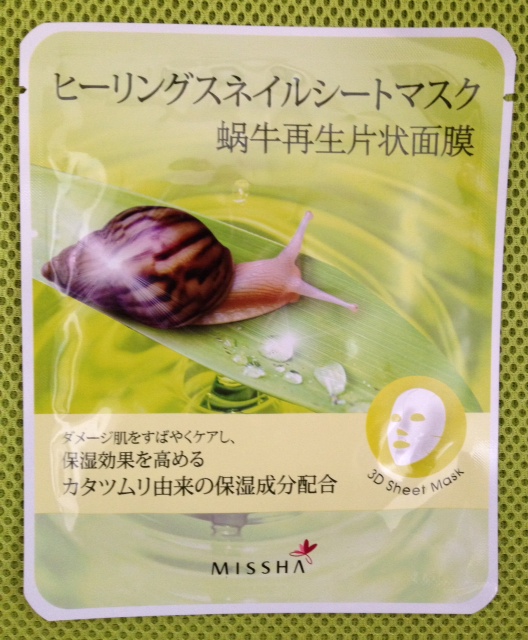
Treatments. By this I mean largely the creams and lotions women buy and use themselves, although there are plenty of places offering facials. A large part of the skincare market includes whitening products not usually available in Europe or North America. Away on a school trip accompanied by graduates, I have seen them (yes, in public) going through elaborate skincare routines requiring many different products and taking many careful minutes of application. Any shop whose clientele includes young women will probably have a vast array of one-off treatments, often face masks. A while ago, a friend at school mentioned that she had tried such a mask, and gave one to me. She had tried it, I believe, through curiosity, and offered it to me in the same spirit. I’m afraid I forgot about it but found it the other day and so, dear reader, I have tried it so I could report. This is the mask I tried:

snail maskIf you can read Japanese you already know what this is, but if you can’t the photo alone may be alarming you while you think, no, surely not. But yes, it is indeed a ‘healing snail sheet mask’. It was made in South Korea, as a lot of these treatment masks are. The directions are to cleanse your face, apply the mask, wait fifteen to twenty minutes and then peel it off. My friend had told me that the mask feels fine as long as you don’t think SNAIL! Putting the mask on my face I found it cold and slightly slimy, but once it was on I felt a little claustrophobic and looked alarmingly Hannibal Lecter-like. Since I couldn’t put my glasses on I busied myself doing some laundry and other chores until the twenty minutes were up. It helped me to not think SNAIL! Once I had peeled it off I must say my skin felt soft and a little plumped up, but I have other skincare products that have the same effect, don’t make me look like a madwoman and don’t contain mashed up gastropod molluscs (or maybe they do . . .).

And so I come to supplements. On satellite TV (and maybe terrestrial TV, I don’t know, I don’t watch it) there are frequent extended adverts for different supplements, many aimed at women. The one that boggles my mind every time I see it (and there are plenty of different brands) is the one marketed as placenta. Yes, placenta. A Japanese friend pointed out ages ago that there is a Japanese work for placenta, but it isn’t used in this case, the word is always written in katakana, the alphabet used for words imported into Japanese from other languages. The main ingredient is usually explained as pig placenta.  I saw this advert on TV a couple of days ago:

placenta

The information on the screen is detailing the benefits of taking the placenta supplement; collagen, amino acids, vitamins, minerals etc. What I found surprising about this particular advert, and something I had never seen before, was that earlier in the broadcast there had been a picture of a mother with a newborn, and the voiceover had explained clearly what ‘placenta’ was (though obviously the supplement uses animal rather than human placenta). There are many other supplements, of course; ones including black vinegar are touted as diet aids, there are special teas with the same effect, and others which, according to the graphics, appear to be glorified laxatives.

A word about the public behaviour of women, particularly in their late teens and twenties. As I mentioned earlier, I have seen extensive skincare rituals carried out in public places. I once watched a woman applying and re-applying coat upon coat of mascara on the train. Between each coat she took out a pair of eyelash curlers and gave her eyelashes a vicious curl. It was quite gruesome to see. There has been a poster on the subways, one of a series to encourage good etiquette and consideration for fellow passengers, making the point that these behaviours are better done in the privacy of your own home.

Finally, I can’t end without mentioning the fascination with eyelids and eye shape. There are words in Japanese for different kinds of eyelids; hitoe mabuta (一重まぶた) or single-edged eyelid and futae mabuta (二重まぶた) or double-edged eyelid. The former is an eyelid without a crease, and there is a cosmetic surgical procedure called Asian blepharoplasty which will transform such an eyelid into one with a visible crease. Should you be too young or feel disinclined to take such a drastic step, it is possible to buy special glue or tape to create a do-it-yourself version, though done with a heavy hand it can be obvious and a little disturbing.

I have lived in Japan for twenty years, but have very little first-hand experience of any of what I have written about. I had my hair straightened a few years ago and haven’t looked back. For that Japanese innovation, I am hugely grateful. For the rest, a lot of it is marketed to address Asian women’s concerns, and I am not Asian. However, I must say, I have an appointment on Monday for a manicure, pedicure and (I hope snail-free) facial and I can’t wait.

Tokyo Snow Day

January 14thAt church yesterday a fairly new Tokyoite asked us about winter here. How cold does it get? About freezing, we answered. And snow? Oh no, we assured him, we hardly ever have snow, and when we do it doesn’t settle.

Twenty-four hours later, and . . . oops. According to an app on my phone the temperature is 1 degree celsius but ‘feels like -7’, and according to a tweet from the UK ambassador we had 3 inches of snow in 3 hours. The transport system is affected; many flights out of Haneda are cancelled and some train lines have stopped. I watched the snow get deeper and deeper this morning and by early afternoon I decided to go for a walk, since we very rarely have a day like this.

Fortunately, today is a national holiday; the second Monday in January is Coming of Age Day (成人の日). It used to be that the ceremony was only for people who had already reached their twentieth birthday, but in recent years it has changed and is now for anyone who has turned or will turn twenty between April 2nd last year and April 1st this year. Also, it used to be held on January 15th and so was a moveable feast, but in 2000 the Happy Monday system was introduced and four National holidays, including Coming of Age Day, were moved from a specific date to a specific Monday every year, to create some long weekends, and therefore, happy Mondays. So, good for most of us, it means we don’t have to work today, not so good for all those new adults who have been trying to get somewhere to mark the occasion. Traditionally, they are invited to the city or ward office to listen to speeches and be congratulated, and then go out with friends or family to celebrate. Men can wear hakama (袴), formal kimono for men (and very smart, too) but can also wear a western suit. This photo, of a bride and groom, actually, will give you an idea, since the groom is wearing a hakama.

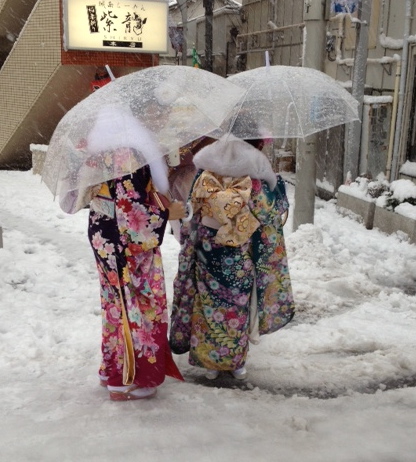
Shinto bride & groomWomen traditionally wear a long-sleeved kimono called a furisode (振袖). They are beautiful and elaborate; usually hairdressers advertise months ahead of time that they’re taking bookings for women to go in early on Coming of Age Day to be dressed in a kimono and have their hair and make-up done. The kimono is accessorised with zori (草履) sandals. Beautiful but not easy to walk in if you’re not used to it, which most young women aren’t, and today must have presented even more of a challenge. I saw these two young women walking gingerly along the road near the station:

Coming of Age Day 2Apart from them, I saw quite a lot of people out in the snow. There were some university students chasing each other along the road having a snowball fight, and a primary-school-age boy came out of his apartment building dragging a bright red sled with a look of absolute delight and chattering excitedly to himself about the wonders before him.

I walked across the railway tracks and saw a train waiting at the station. A little further along I saw the two young women in kimono. Just a few metres past them, the pachinko parlour was open, and one of the employees was hosing down the road in front. I saw a lot of shops and other businesses trying to clear the bit of road in front of their building, but usually with a shovel or a broom. This was the only place using water to blast the snow away, but with temperatures hovering around freezing it seemed like a recipe for disaster.

I walked along the shopping street as far as the supermarket. By then my toes were cold, so I was happy to find it was warm and toasty inside. I didn’t really need to go shopping today, but I bought some mikan (tangerines) and extra vegetables and tofu to add to my green curry this evening. On the way back it seemed like the snowflakes were a little smaller and wetter, but there was an icy wind making everything feel colder. Back across the railway tracks, and the same train was still at the station, with announcements being made that one of the lines had stopped, at least.

I trudged back up the hill to my apartment and was relieved to get home, have a mug of hot chocolate and settle down to write this post. I thought I could hear that the snow had turned to rain, but when I went outside to check I found it’s still snowing but it’s quite wet now. Tomorrow we’re all back at work, we’ll have to see if everything freezes overnight and what effect that will have, but for now I’m going to stay warm and snug at home.

January 14th