Category Archives: UK

Peace in the heart of Tokyo

Although I have lived in Japan for about 20 years, and in Tokyo for almost 15, I still love exploring the city and showing people around. Yesterday afternoon I had the chance to show a new Tokyoite around, lucky me! We managed to see quite a lot in two and a half hours; we did a lot of walking and experienced the collision of traditional and modern, peaceful and screechingly raucous, autumn colours and teenage fashions.

The route we took started at Meiji Jingu, then down Takeshita Dori, over to Omotesando (past Kiddyland, a brief stop in Oriental Bazaar and a short visit to Union Church), along Cat Street to Shibuya (stops at Muji and Tokyu Hands) and ended at the Hachiko statue in front of Shibuya station.

Today was a very busy day at work; I didn’t feel like I stopped all day, and in the middle of it all a colleague did something really annoying which left me in a kind of fizzy, mentally-hopping-up-and-down state. Not conducive to sleep; even though I am tired and it’s after 1am, I am sitting here, pecking out my frustrations and feeling the tension slip away as I focus on what I saw yesterday afternoon.

Meiji Jingu (Meiji Shrine, 明治神宮) is a 175-acre forest in the heart of Tokyo. It was built to commemorate the Emperor Meiji and his wife, the Empress Shoken. It was flattened (like almost the whole of the city) when Tokyo was firebombed in World War II, but rebuilt, and it’s a place of extraordinary beauty and peace. Some of the trees are huge and the torii (the wooden gateway to the shrine) towers over the visitors. It is a vast, green space, and the shrine itself is beautiful. It’s very simple and always gives me a feeling of great stillness. There is something about the wood everything is made of, it feels organic and almost as if it grew out of the forest.

Meiji Shrine 2

In front of the shrine is a place where anyone can write their prayers and leave them to be offered by the priests. It is amazing how many different languages are represented on these ’ema’ (絵馬), or votive tablets. So many people come to this place and open their hearts to the universe, and when they go home they leave their hopes and prayers mingled with countless others, wood on wood, open to the elements, to prying eyes and other people’s cameras.

Prayers at Meiji JinguSometimes it is good to feel small. To stand under a towering torii and feel as tiny as an ant, to know that the nature surrounding you is vast and ancient, that the paths lead into the forest, but also back to traditions and beliefs that have guided and strengthened people through hundreds and thousands of years. Whatever your faith, it is good to stand there, let your tensions and worries go, and feel your spirit soar.

Meiji Shrine gateway

Advent Sunday, 2012

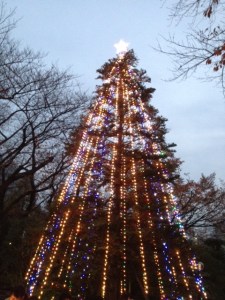
Christmas TreeI work at an Anglican school, and every year, on the Friday afternoon before Advent begins, we have a short service for the lighting of the tree. We don’t get a special Christmas tree every year, instead we decorate the large conifer at the top of the drive. The chaplain leads us in prayer, we sing a carol (It Came Upon A Midnight Clear, sung to the American tune which always reminds me of Home On The Range), the tree is lit and the choir sings Joy To The World. We stand at the top of the drive, effectively blocking the way out of school and so swelling our numbers with any girl on her way home but lacking the gall to wriggle through the throng. Before the short service we are issued with candles inside paper cups, this year handed out with warnings to hold the cup carefully; it seems the hole in the bottom was a little big and to hold only the candle would be to invite danger. I had never noticed before, but after the tree was lit I saw a member of the office staff inside the tree; I imagine he had been tasked to flick the switch and was then stranded but illuminated, wondering where he should go.

So the tree is lit, and while all the shops seem to think it’s Christmas already, I am looking forward to Advent. School has been particularly hectic recently; we are in the middle of speaking tests, so I suppose that’s not surprising. Squeaking through the tests with my little froggy croak has entertained the girls no end but has been quite a frustrating experience, and I shall be glad to finish everything and stop talking for a while. We have two more weeks of work; tests, grades, preparation, and then I fly back to the UK for Christmas there.

Today I have been struck by sounds; this occurred to me when I heard the 5 o’clock chimes, which are broadcast every day, as far as I know all over Japan. I have always believed that it is a traditional way to alert schoolchildren to the time and that they should be on their way home. I think every ward in Tokyo plays a different melody. I have also read, however, that it is a way for the ward office to check that the emergency announcement system is working (in case of earthquakes etc.), but I prefer to think it’s a service to Japan’s children. I sat here listening to the chimes and thought about other sounds that I had heard today.

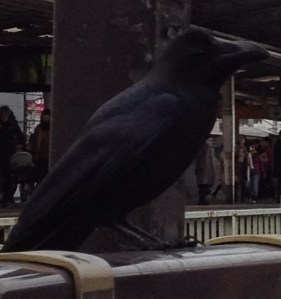
Earlier this afternoon, when I was on my way home, I saw a crow sitting on a railing near the station. Japanese crows are very big, not easily intimidated, the kind of bird to sit calmly on a railing only a metre or so away from you, regarding you with darkly glittering beady eyes and occasionally cawing in a raucous and territorial way. This one let me take its picture, it’s quite dark but I shall include it anyway:

CrowMy day started with a quiet service at church, space and peace after a long week. On the way home I stopped at a 2nd-hand bookshop and bought a copy of The Makioka Sisters by Junichiro Tanizaki. It is the same edition I read when I was at secondary school. I re-read it when I was living in Japan in the early nineties, and I have been feeling the urge to read it again. To find a worn copy with the same cover I remember from 1987 almost makes me feel like I have found my own copy again! I shall look forward to reading it over the holidays and blog about it later.

Makioka SistersThe end of another weekend. I have spent time with good friends, in person and on the phone. Despite my inclination to sleep away part of this afternoon, the universe conspired against me and instead I had a long chat with an old friend, a much better way to spend the time. I feel connected and my batteries are re-charged; I’m ready for another week.

My hobby is sleeping

I have been a very bad blogger, and my excuse is general busy-ness and an evil cold which gravitated, as they always do, to my throat and took my voice away. I thought several times over the past week about this other voice I now have, but was too floppy and pathetic to galvanise myself into action. However, today, November 25th, would have been my Grandad’s 112th birthday (Happy Birthday, Grandad!) and he was fond of declaring, ‘The less you do, the less you want to do!’, so with his voice ringing in my ears, I shall update my blog.

‘My hobby is sleeping.’ Another of those sentences anyone who has lived in Japan will probably roll their eyes at, because at some point a Japanese person will have told them this. Since I got up very early this morning to go to church but promised myself as I did so that I would come home and sleep for a few hours this afternoon, I thought this was a timely topic. I was also inspired to write about this a while ago when I noticed on Facebook that over 22.8 million people ‘like’ sleeping. I must admit that I find these random lists of people’s ‘likes’ unintentionally funny; ‘Purplegirl likes the Dalai Lama’, ‘Purplegirl likes Yorkshire Tea’. It implies I like them in the same way, that one ‘like’ fits all. Then there are the combinations of my friends who have never met; ‘A and B like reading’, ‘C and D like Marmite’, and I think, how can this be so? They don’t know each other, oh, wait . . . and so I come back to sleeping, and the 22.7 million people who ‘like’ it.

I went to the Facebook page for ‘liking’ sleeping, and clicked on the 22.8 million plus people who are fond of this ‘naturally occurring state’. Scrolling through the first twenty or so, I found quite a number of names of Japanese people or people identifying as living in Japan. Of course there were plenty of names which didn’t fit into either category, but what is it about sleeping that makes it appeal to people in Japan as a ‘hobby’?

First of all, it seems absurd, since in my experience Japanese people I have met often take their hobby much more seriously than people in the UK. Once we are adults, I think people in the UK would regard a hobby mainly as something they enjoy doing. If it is a sport, a musical instrument or some other kind of cultural pursuit they may have studied or practised at some point earlier in their life, but by adulthood have reached a kind of plateau, where it is fun, relaxing or rewarding. In contrast, I know a lot of Japanese people who continue to take classes in their chosen hobby throughout their life. It could be something traditional, like ikebana or tea ceremony, kendo or calligraphy, or something more readily identifiable to people in other countries; a sport or a musical instrument. I have known wives of retiring ‘salarymen’, alarmed at the prospect of their husband underfoot at home all day every day, slot a number of classes for hobbies into their husbands’ newly-free schedules until they are almost as scheduled as they were at work. Developing one’s skills is a serious business. I feel it is probably an extension of the attitude to the traditional arts and sports, where you would expect to spend a lifetime perfecting skills under the tutelage of a more experienced practitioner.

This attachment to the idea that ‘my hobby is sleeping’ seems to be a more recent development, and maybe one that grew out of the mother of all sleep-deprived times, the bubble. As I have mentioned before, I have friends whose memories of those years is something akin to a worker bee with very little time to re-charge the batteries. Get up, go to work, work, go home, eat, sleep, repeat. I can see that in such an environment you would indeed start to schedule time to catch up on sleep; that it would indeed take on the feeling of some luxury commodity that even money couldn’t buy.

While their parents were beavering away at the company, Japanese teenagers post-war clambered on the hamster wheel of studying, the cram school or juku (塾). It is still big business and many students go to one after school at various points in their academic career, usually in the years preceding entrance exams. Since there are entrance exams for primary schools, junior and senior high schools and universities that’s a lot of cramming. The school day in Japan starts before 9am and classes finish around 3pm. After that there’s dismissal, cleaning and school clubs and then, for a great many students, cram school. It’s not uncommon for them to get home after 9pm, so that’s a 12-hour-plus day. No wonder sleep seems so appealing.

I am left with two contradictory impressions of Japanese ‘hobbies’; there are the people who make a life-long study of something, and then there are the exhausted millions who fall asleep on trains, the students who can put their head on a desk and be fast asleep in seconds, and all the people, of all ages, across the country, who even as they start a new week tomorrow will be promising themselves a nice long sleep next weekend.