Category Archives: Tokyo

Hello 2013

DSCN0525Happy New Year! When I went out this morning the sky was blue and the sun was shining; one of those bright, crisp Tokyo days that make winter here far easier than the grey days of the UK. It was only about 7am, but there were a few people about, and the trains and buses were running on the weekend / holiday timetable. While most people will be off work until January 3rd, there will be a lot of visiting relatives and shrines so we need to be able to get about.

Even so, I was surprised to see so many people out so early. When I transferred onto the Yamanote Line (the overground loop line around Tokyo) it seemed that there were 3 kinds of people; ones with suitcases maybe going skiing or to visit relatives outside Tokyo, ones on their way to a shrine or to visit people in Tokyo (no suitcases!) and the bleary-eyed, bundled-up people who looked like they’d been out all night and were only just on their way home. Now, before you start to think that these are people who have been partying all night, that is not what I mean. At midnight Buddhist temples ring their bells 108 times (because there are 108 kinds of sins) and sometimes people in Tokyo travel down to Kamakura or maybe out to Narita-san in Chiba, or another temple they like, and see the New Year in there. I think if you get there early enough you can sign up to ring the bell for one of those 108 times. Anyway, there can be quite a crush at the temples, shrines and stations, and so it can take time to get home.

The shrines and temples of Japan will be busy paces over the next few days, while people observe Hatsumode (初詣). This is the first shrine visit of the year, which most people will try to do over the next 3 days since they are not at work, but I believe can be done in the first eight days of the new year. It is strictly the first (Shinto) shrine visit, but some people will visit a Buddhist temple instead. The most popular shrine in Tokyo is Meiji Jingu (明治神宮), which I wrote about before (https://tokyopurplegirl.com/2012/12/05/peace-in-the-heart-of-tokyo/) and which millions will visit over the next few days; in Chiba Narita-san is popular, and in Kawasaki the place to be is Kawasaki Daishi, which I went to one year and can confirm it is indeed extremely crowded. As well as praying, it’s customary to buy a new lucky charm or amulet and get a piece of paper with your fortune written on it. If you like what you get (there are different levels of luck) you take it home with you; if you don’t, you tie it to the branch of a tree in the shrine precincts and leave it there, probably getting another one at another shrine and so on until you get one that suits; a kind of holy fortune-shopping, I suppose.

Another shrine-related activity for New Year is a Seven Lucky Gods pilgrimage. Every part of Tokyo has at least one; Shinagawa has 2. I’m going to do one in Meguro on Saturday and will blog about it then, but on my way home I met a couple (he was Japanese, she was American) in the middle of the local pilgrimage, trying to find their way to the next shrine on the map. They had stopped 3 passing youths but didn’t seem to be getting anywhere, so I stopped to help too. She rolled her eyes and said ‘he doesn’t know how to read a map’ (a failing with which I sympathise completely). Luckily, I didn’t need to read the map, I just needed to see that they were doing the pilgrimage and on their way to the shrine near my local supermarket, so I was able to give directions.

I didn’t see many shops open (except for convenience stores), but my local flower shop was open. There is a very large hospital just across the road, and maybe they thought people visiting relatives in hospital would stop to buy flowers, but that doesn’t explain the vast array of plants also on sale, since that is a most inappropriate gift for someone in hospital; you wouldn’t want them to take root there like the plant has done in its pot.

The local wagashiya (和菓子屋) or Japanese confectionary store was closed, of course, but already had fukubukuro (福袋) or lucky bags displayed in the window:
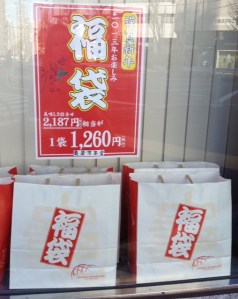
lucky bagsMost stores will be selling them over the holiday period; you buy a bag of unspecified goodies (in this case for ¥1,260, which is £9 or $14.50) and take your chances. Even clothes shops sell them; you buy according to size but know nothing else. The contents are worth more than the price you pay (otherwise they would be very unlucky bags indeed) but some can be expensive; ¥10,000 is not unusual, and that would be over £70 or $115.

While Christmas has become a new Japanese tradition, what all Japanese children and young people were looking forward to today was the otoshidama (お年玉); small envelopes with money inside. Along with New Year cards there is a dazzling variety of designs available in December. I bought these (for research only!):

otoshidamaSince we are now in the Year of the Snake (at least according to Japan, China will wait for the Lunar New Year, this year falling on February 10th), you can see there is a rather appealing snake on top of Mt. Fuji. Japanese people are traditionally avid savers, and this is a habit learnt early in life. The money received in these envelopes will ideally be saved; in reality I think by their teenage years a more realistic goal would be to save half and spend half (on lucky bags)!

I hope the Year of the Snake will be a good one for all of us; I wish you peace, joy and love in the year ahead.

snake

Goodbye 2012

Tokyo is slowly shutting down as the New Year approaches. To a visitor the city might look crowded, but the trains and buses are not crowded at all and instead of the usual rush and bustle there is a more relaxed, but still purposeful sense of activity. People are stocking up for the next few days, since everything except convenience stores will be closed tomorrow. As with many other countries, every year more and more shops open earlier and earlier so by January 2nd there are plenty of places to go if you fancy a bit of retail therapy.

Many years ago, everything closed for 3 days, and everyone spent time with family. In the days leading up to New Year, everyone pitched in to do a big clean and special New Year dishes collectively called ‘osechi’, each with a symbolic meaning, were prepared. These days, at least according to the Japanese people I know, people do clean but not necessarily with the fervour of yesteryear, and the osechi dishes are eaten on the 1st but not in vast amounts. They are very expensive if bought in a department store, and hugely time-consuming to make at home.

My version of Japanese New Year is quiet, but since I have only just come back from the UK the whole Giant Cleaning binge is lost on me. I haven’t the energy or the time; I prefer to do my spring-cleaning in spring when I can open the windows and let fresh air in without freezing.

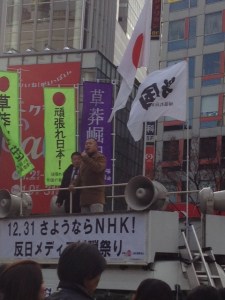
Despite the general air of winding down, I was surprised to find a noisy demonstration taking place outside Shibuya station. There were dozens of people standing there with large Japanese flags and placards, listening to a very angry man on top of a campaign truck who was very exercised about NHK, the national broadcaster. His comments and the placards were the same; that NHK is anti-Japan, anti-emperor and pandering to China. In the course of his screeching, Mr. Angry announced that later in the afternoon they would all march to the central offices of NHK and demonstrate there. Not everyone was winding down, it seemed; he was very clearly winding up himself and everyone listening.

NHK protest

Continuing the general theme of angry shouty Japanese men, Japan has wrapped up the year electing the right-wing LDP (Liberal Democratic Party), is still embroiled in territorial disputes with China and South Korea, and the economy is looking shaky. The new government seems keener on keeping nuclear power than the rest of the population, but just to reassure us all Prime Minister Abe has appointed a Minister for Nuclear Emergency Preparedness, Nobuteru Ishihara,  spawn of former Tokyo governor Ishihara. So that’s all right then.

Today’s Daily Yomiuri newspaper has a centre spread of the Top Ten Domestic news stories of 2012. They are:

1. Yamanaka wins Nobel Prize for iPS research                                                                                 2. Tokyo Skytree opens                                                                                                                      3. Uchimura, Yoshida shine in London Olympics                                                                              4. LDP wins Lower House poll, retakes power                                                                                  5. Japan-China ties sour over Senkakus                                                                                           6. Annular solar eclipse seen from Tohoku to Kyushu                                                                       7. Ceiling panels fall in Sasago Tunnel, killing 9                                                                                8. Giants win 1st championship in 3 years                                                                                        9. Final Aum fugitives arrested                                                                                                        10. Multiple murder mystery linked to Miyoko Sumida

I wonder how many of those made the news outside Japan; I think I can only say with confidence that four did. Plenty to blog about then.

I bought some sushi and came home, posting my New Year greeting cards on the way back. To be delivered tomorrow they should have been posted by the 25th, but I didn’t get my act together before I flew back to the UK and so they will be delivered a couple of days later. I also bought a bag of mikan, or mandarin oranges, and plan to do very little for the next few days.

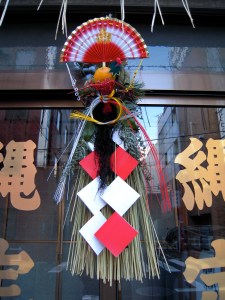
As I walked home I saw a lot of traditional New Year Shinto decorations on windows, gates or doors

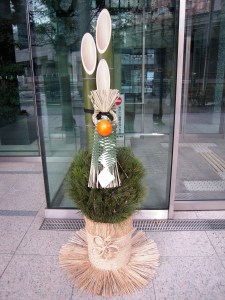
DSCN0521and some businesses already had the pine and bamboo decoration called ‘kadomatsu’ (門松) outside

DSCN0524The sky was pink as the sun set and the neighbourhood seemed very quiet.

Dec 31stAs I write this, I can hear the neighbourhood volunteers walking down the road, warning us to be careful about fire hazards in our homes. On TV I have just watched an advert for dietary supplements for women, made from pig placenta, and the BBC, bravely ignoring all of the above news stories, have once again broadcast one of their ‘Japanese obsession’ stories, this time about a supposed obsession with cuteness and a school where you can train to be a mascot and spend your days inside a large furry suit. Sigh. As I have written this I have made a mental note to write more about a lot of things I’ve mentioned, but for now this is my snapshot of the end of the year.

Goodbye 2012. You were an improvement on 2011, but you could have been better. Let’s see what 2013 brings us. Now I am snuggled up at home, it’s time for sushi!

メリークリスマス*: Being festive, Tokyo-style

Although it is still more than ten days to Christmas, I am posting this now, because tomorrow I am flying back to the UK for a fortnight and don’t know if I’ll be able to post anything while I’m there. I have been enjoying Advent; the waiting and the anticipation, but I have also been caught up in a storm of marking, end-of-term work and Christmas shopping. Now I have finished all my work, and I’m kind-of-packed, so I thought I’d sit down and post something.

Mid-December in Tokyo doesn’t feel like mid-December in Europe; the skies are blue almost every day, the leaves are red and yellow, and the temperature is around 10 degrees during the day, falling to around 2 or 3 degrees during the night.

gingko 3               Maple

Of course, Christmas is all around. That is, if Christmas to you means the same as it does to my local stores; a bucket of KFC chicken and a synthetic-looking strawberry shortcake from the 7-eleven; if your local church thinks that the perfect way to decorate the building is to do this:

christmas tree 2

Why is the cross zooming off into space? Why does that say ‘Christmas’?

My neighbours have got in on the action too, with a great variety of flashing lights on their veranda. These are the same neighbours who in summer think that if one wind chime producing a light tinkling sound is relaxing then six lined up in a row will surely amplify the relaxation, so I probably shouldn’t be surprised. I’m just glad I don’t have to pay their electricity bill.

So what does Christmas mean to most Japanese people? Although people in Japan would identify predominantly as Buddhist or Shinto, there are probably between one and two million Christians of different denominations. However, there are a lot of well-known schools and universities that were founded by missionaries in the 19th century, so while there are not many people calling themselves Christian there are far more who were educated at Christian schools and so attended services or studied the Bible. In addition, Christian-style weddings held in hotels are popular; the white dress, the ‘minister’ (not always an ordained person, it could be a random foreign resident playing dress-up for his part-time job), and the chapel. I think most Japanese people have some idea what it’s all about.

However, knowing what the meaning of Christmas is and choosing how to celebrate it are quite different. In Japan, Christmas Eve is THE date night of the year. Tokyo Tower is a popular spot, with it’s twinkly lights and romantic photo opportunities. This year, Christmas Eve will be a national holiday, since December 23rd is the Emperor’s birthday and, falling on a Sunday, it gets moved to the Monday. Christmas Day will be an ordinary working day, but ask people what Christmas Day dinner should be and you will get the answer: ‘chicken’. Well done, KFC, you have quite masterfully convinced a whole country that Christmas equals vast amounts of deep-fried gristle and little pots of sweetcorn and mashed potato, or whatever it is that you sell. The persuasive campaign starts the same way every year; the Colonel Sanders mannequin, dressed as Santa, outside the shop well before Christmas. Truly, the home of Christmas deliciousness.

And what of dessert? Santa wears red, Christmassy things are often red . . . strawberries are red! Let’s eat strawberries! But, I hear you protest, strawberries are summer fruit, in winter they will be watery and tasteless, and I say: yes. But they are red, and therefore Christmassy. Strawberry shortcake must be the perfect Christmas dessert, it’s red like Christmas and white with creamy snowy goodness. Since October, my local convenience stores have had information on the wall about the Christmas cakes you can order.

This is the stereotypical Japanese Christmas experience, the almost Disneyfication of an ancient  and sacred celebration but really, how many people in Europe and North America have the same approach as the Japanese?

Down the road from where I live, on Christmas Eve the local Anglican church will be packed to the rafters for the Midnight Eucharist. At school we have a nativity set, as we do every year. The crib is empty at the moment, of course, and this year I have not seen any inappropriate objects there; last year I removed a small purple dinosaur one day. We had Christmas carol practice yesterday, including my favourite original Japanese carol: Hallelujah Christmas. The title pleases me and it’s unlike any of the carols I grew up with.

Over the years I have heard foreign residents living here complain about Christmas Day being an ordinary working day, but really, that’s what it is. If you want to go to church, if you want to stop and  hear the Christmas message, you have to make the time for that yourself. You have to carve out a Christmas-shaped space in your life, because no one is going to declare a national holiday, close all the shops, shut down almost all public transport and make you stop. You have to do it yourself. I have always liked that, I like it being a conscious decision. If you end up with a Christmas that doesn’t suit you, you did that to yourself. The churches have services, the transport system if running, you can go where you want, do what you want; you just have to make a conscious decision to step out of your everyday routine and say, this day is special to me.

For now, though, it’s 10 days away. The 5 o’clock chimes have just reminded me it’s time to stop playing, so I shall end this post here and finish my packing. I wish everyone a special Christmas, one that suits you and has real meaning for you, whatever that may be.

nativity * メリークリスマス = Merry Christmas