Author Archives: tokyopurplegirl

Bee stings in my brain

I am gradually resurfacing from a particularly long migraine. When I started this blog I aimed to post something Japan-related once or twice a week, and apart from the time I have spent in the UK I have managed that. This time last week, I had just been out for a walk in the snow, and enjoyed writing a post about it. Then the atmospheric pressure dropped suddenly and I found myself with a migraine that would just not budge. Today is Day 8, and I am hoping that surely, it can’t last much longer. But I am also thinking that this is something that happens often and therefore it would be useful to write this (unrelated to Japan) post to explain my occasional absences.

So, migraines. Not just a type of headache, not cured with paracetamol (acetaminophen) or other over-the-counter medicine. I have been living with them for over thirty years, but for the first ten years or so they were not diagnosed. I saw the doctor frequently, yet despite describing what surely is a typical migraine (pain on one side of my head, sensitivity to light, nausea) I was told I had either sinusitis or was so stressed I had somehow made half of my head go into some kind of spasm. When I finally worked it out for myself and told the doctor I thought they were migraines, he remarked quite dismissively that it was quite probably so, but that I could still stand up and many people who have migraines can’t, so I should just go home and take cocodamol (paracetamol with codeine, available OTC in the UK after Mrs. Thatcher deregulated a lot of such medicines to save money for the NHS).

Encouraged by a pharmacist at Boots who had studied migraines, I went back to see a different doctor and asked for prescription medicine and so began a long period of trying different things to find what worked. I tried beta blockers (Propranalol), Amitriptyline, epilepsy medicine (Topiramate) and refused to take Prozac. I tried acupuncture and feverfew. Nothing worked, and Topiramate made everything much worse even after I stopped taking it. I cut out what I found were triggers; cheese (except fresh cheese like cottage cheese) and red wine, and cut down on the fermented foods I knew could make an attack more likely. I gradually made a list of all the things that make an attack more likely, and this included: hormonal fluctuations, food triggers, lack of sleep, stress, excessive computer use (!), fluorescent lighting and low atmospheric pressure. I found a medicine that did work; Sumatriptan, branded as Imigran in the UK, Imitrex in the US. I also found what helped when I did have a migraine; avoiding all the things listed above where possible, plenty of sleep, ice packs at the base of my skull or over my eye where the migraine started and ended, conversely long, hot showers and prayer. This last one might seem out of place, but really, when a migraine goes on and on it’s easy to feel stressed or panicked and a time of prayer or quiet meditation helps me to ease that.

I grew up in a family where I was the only one to have migraines; consequently no one recognised what was happening to me. It was a relief to finally know what the pain was, that it wasn’t just headaches and that I wasn’t pathetic to be unable to cope. It was a relief to hear other people describe the pain in the same way; like a bruise in the brain. I was told recently that the brain has no feeling, so the pain I feel is around my brain, but it feels like it’s in my brain. It made sense to me when I read in the Oliver Sacks book on migraine that the chemical secreted during an attack is similar to a bee sting, because that’s what it feels like. (I did look through the book this evening to try to find the page reference, but I couldn’t find it.)

If you suffer from migraines, you have my sympathy. If you don’t, but know someone who does, be gentle with them. They don’t have a headache, they have a migraine, and it’s not the same. The people who declare, ‘I have a migraine,’ when they mean they have a bad headache, are as wrong as someone with a bad cold announcing that they have ‘flu. A migraine is like a headache only because they are both pain in the head, but beyond that the similarity ends. You may have a bad headache, but if you take some paracetamol or ibuprofen the pain will stop; I have someone hammering bee stings into my brain and sometimes not even Sumatriptan can stop it.

It seems I am coming out of this most recent attack. I hope I won’t have another for a while, I am feeling quite drained and my head is sore. But I am back on my blog, and will have something Japan-related very soon.

Tokyo Snow Day

January 14thAt church yesterday a fairly new Tokyoite asked us about winter here. How cold does it get? About freezing, we answered. And snow? Oh no, we assured him, we hardly ever have snow, and when we do it doesn’t settle.

Twenty-four hours later, and . . . oops. According to an app on my phone the temperature is 1 degree celsius but ‘feels like -7’, and according to a tweet from the UK ambassador we had 3 inches of snow in 3 hours. The transport system is affected; many flights out of Haneda are cancelled and some train lines have stopped. I watched the snow get deeper and deeper this morning and by early afternoon I decided to go for a walk, since we very rarely have a day like this.

Fortunately, today is a national holiday; the second Monday in January is Coming of Age Day (成人の日). It used to be that the ceremony was only for people who had already reached their twentieth birthday, but in recent years it has changed and is now for anyone who has turned or will turn twenty between April 2nd last year and April 1st this year. Also, it used to be held on January 15th and so was a moveable feast, but in 2000 the Happy Monday system was introduced and four National holidays, including Coming of Age Day, were moved from a specific date to a specific Monday every year, to create some long weekends, and therefore, happy Mondays. So, good for most of us, it means we don’t have to work today, not so good for all those new adults who have been trying to get somewhere to mark the occasion. Traditionally, they are invited to the city or ward office to listen to speeches and be congratulated, and then go out with friends or family to celebrate. Men can wear hakama (袴), formal kimono for men (and very smart, too) but can also wear a western suit. This photo, of a bride and groom, actually, will give you an idea, since the groom is wearing a hakama.

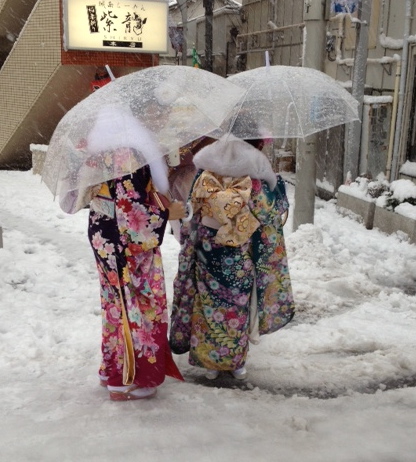
Shinto bride & groomWomen traditionally wear a long-sleeved kimono called a furisode (振袖). They are beautiful and elaborate; usually hairdressers advertise months ahead of time that they’re taking bookings for women to go in early on Coming of Age Day to be dressed in a kimono and have their hair and make-up done. The kimono is accessorised with zori (草履) sandals. Beautiful but not easy to walk in if you’re not used to it, which most young women aren’t, and today must have presented even more of a challenge. I saw these two young women walking gingerly along the road near the station:

Coming of Age Day 2Apart from them, I saw quite a lot of people out in the snow. There were some university students chasing each other along the road having a snowball fight, and a primary-school-age boy came out of his apartment building dragging a bright red sled with a look of absolute delight and chattering excitedly to himself about the wonders before him.

I walked across the railway tracks and saw a train waiting at the station. A little further along I saw the two young women in kimono. Just a few metres past them, the pachinko parlour was open, and one of the employees was hosing down the road in front. I saw a lot of shops and other businesses trying to clear the bit of road in front of their building, but usually with a shovel or a broom. This was the only place using water to blast the snow away, but with temperatures hovering around freezing it seemed like a recipe for disaster.

I walked along the shopping street as far as the supermarket. By then my toes were cold, so I was happy to find it was warm and toasty inside. I didn’t really need to go shopping today, but I bought some mikan (tangerines) and extra vegetables and tofu to add to my green curry this evening. On the way back it seemed like the snowflakes were a little smaller and wetter, but there was an icy wind making everything feel colder. Back across the railway tracks, and the same train was still at the station, with announcements being made that one of the lines had stopped, at least.

I trudged back up the hill to my apartment and was relieved to get home, have a mug of hot chocolate and settle down to write this post. I thought I could hear that the snow had turned to rain, but when I went outside to check I found it’s still snowing but it’s quite wet now. Tomorrow we’re all back at work, we’ll have to see if everything freezes overnight and what effect that will have, but for now I’m going to stay warm and snug at home.

January 14th

Tokyo at three miles an hour

On my way home from church today I read a BBC article about a journalist who is going to spend the next seven years walking from the Rift Valley to Tierra del Fuego, following in the steps of the first humans as they spread from Africa across the globe. You can read the whole article here: http://www.bbc.co.uk/news/magazine-20902355. Of course, it’s a huge undertaking, with some parts fraught with danger, and he will have a lot of support even if he is largely walking alone or with local guides. What struck me, what stuck in my mind, was the idea that our brains have evolved to absorb information at 3mph / 5kph, or the average walking speed. Now, I am no scientist, so I can’t say if this is correct, but the concept appeals to me, because this is how I like to soak up the sights and sounds of Tokyo.

I have already written a number of posts about walking in Tokyo. Although this is a huge city with an enormous population, one of the 21st century’s megacities, Tokyo is really not so big and much of is it easily walkable; it’s largely flat, it’s not hard to find a roadside map and if you are map-challeneged like me you can always ask someone. There are three kinds of walks I enjoy; following railway lines, walking around neighbourhoods and pilgrimage routes.

Over ten years ago, I got the idea, I don’t remember from where, that I would like to walk around the Yamanote line in one day. The Yamanote line is the overground loop line around Tokyo. It is 34.5km long and carries over three and a half million passengers on an average day. There are twenty-nine stations and a full loop takes approximately one hour. Anyway, I was taken with the idea of an urban hike and luckily for me it also appealed to a friend who agreed to do it with me. It took fourteen hours (including breaks) and is probably the topic for a post all of its own, but it was that mammoth trek which confirmed for me that the best way to see the city was on foot. That day, when the cherry blossoms were in full bloom, is still clear in my mind, even over a decade later. Three years ago we repeated the walk, on the last day of the year; we shaved a couple of hours off our previous time and counted off each station as the remaining hours of the year ticked away. Same blisters though.

Even before that walk, I had enjoyed exploring different areas of Tokyo, Yokohama and Kamakura; there are a number of guidebooks available. Yanaka became a favourite, but wherever I walked I always discovered something ; a century-old rice cracker shop, where the third and fourth generations of a family were working; a shop selling a skin-whitening treatment made from nightingale droppings; traditional Japanese houses, modern architecture, and the occasional Swiss chalet. So much of Tokyo is small neighbourhoods, with local parks and shrines and temples tucked in with everything else.

The pilgrimages are a relatively new discovery for me. I did the Yamate route for the first time only a few years ago, but am excited to find a new way to explore. I have only done two out of the twenty-four so far, but I intend to do more.

After we completed that first Yamanote line walk we returned a few weeks later, armed with coffee from a nearby Starbucks (not nearly as easy to find as it is today) and did a victory lap. Our fourteen-hour marathon was condensed into a one-hour swoop around the city. That, too, is a fascinating view of the changing cityscape, and an easy way to give a visitor a brief idea of all that Tokyo is. Nothing can compare, though, to just walking and looking, feeling your feet on the ground, knowing that you are just a tiny part of a vast city. Whether you are in Tokyo or elsewhere, it is a rewarding way to spend an hour or more. Slow down, take in the world at three miles an hour. Sometimes, you can see more by doing less. You can go further by traveling a shorter distance. Even in a big city, finding the places that appeal to the senses, that take root then resonate in memory no matter how much time has passed; this is how I have nibbled Tokyo bit by bit, and have found ‘my’ Tokyo, the one that reflects all the reasons I have made it home for so long.

Marunouchi