Author Archives: tokyopurplegirl

June 4th all over again

June 4th 1989. I wonder if you remember where you were that day. I do. It had been a strange few weeks leading up to that day.

On April 15th I had been part of a small group going from Sheffield to London to welcome a delegation from Anshan in Liaoning province in north east China. Anshan and Sheffield were twin towns (sister cities), linked because of the steel and coal industries. I remember waiting outside Sheffield Town Hall with the woman in charge of the city’s relations with its twin towns, listening to sirens. A lot of sirens. We waited for the car that would take us down to London, and we asked ourselves what on earth could be going on that there would be so many emergency vehicles on the roads.

As we made our way down to London we listened to news reports and gradually learnt what had happened at Hillsborough. How so many Liverpool fans had been crushed to death in the stadium. By the time we reached the hotel that evening it was clear that something heartbreakingly awful had happened. There were 96 fatalities and the relatives of those victims are still waiting for the whole story and justice.

The next day we met the six people who had come from Anshan, and then began several days of surreal sight-seeing. I was the interpreter, but I was told not to mention what had happened in Sheffield. We were to tell them just before we got back to the city. We went to Windsor, to Eton, to Stratford-upon-Avon, and in the evenings we watched the news and carried the sadness in our hearts.

As we approached Sheffield I told them what had happened, and explained that the city was in mourning. We hoped they would understand if people seemed subdued. They listened carefully, then asked, ‘How many people did you say had died?’ ’96.’ ‘And they were from another city?’ ‘Yes, they were from Liverpool.’ ‘Only 96 people and not from your city, then . . . ‘ I remember feeling amazed at the cold-hearted calculations.

There was something else on the TV news every day. Something else we were not to mention to our Chinese guests. There were protestors in Tian An Men Square. They had gone there first to mourn the death of Hu Yaobang, but like the protestors in Turkey today, it quickly became a bigger movement. The students wanted democracy, and they besieged the Great Hall of the People for weeks. President Gorbachev visited China during that time and could not enter the building from the square because of the on-going protests. It went on for about seven weeks, and then on the night of June 3rd/4th they sent in the soldiers. How many died that night? No one knows. Hundreds? Thousands?

I remember going to church on the 4th and someone asking me what was going on, they thought I might understand it since I had lived in China. After all the optimism, after the occupation of the square for weeks without violence it had all become terrifyingly bloody. I had no answers.

One year later I was living in China, teaching at Shenyang Teachers’ College. It was a strange time. I had gone back as much to improve my Chinese as to teach English, but with the exception of 2 brave young women it was difficult to find Chinese people willing to be friends. I asked if I could get a daily newspaper; I was told it would be arranged, but it never was. My students doubled as the censors of my mail, they knew my news from home before I did and weren’t afraid to tell me so. But quietly, I heard the personal stories of some of the students. How they had all been told to go home in May, do not go to Beijing, do not pass go, but really many had gone, showing their student cards and getting a free ride to the capital.

There had been a small pro-democracy movement on campus; the leader was being held somewhere. He was released and one day appeared at the back of my class, back against the wall, nervous, suffering from eczema, too anxious to talk much. I heard that he had been held for months in solitary confinement, with nothing to do. He had been alone with his thoughts for a very long time. As suddenly as he appeared, he was gone again. I don’t know where he went. He might have dropped out, just gone home to his parents. I hope that’s what happened.

On June 4th 1990, all classes were cancelled. Apparently not because it was the first anniversary of what had happened in Tian An Men Square, but on some pretext. It was a strange, quiet day, made stranger by the entire phone system in the college not working. The people who had told me they had been to Beijing the previous year had no desire to try the experiment again. One day around that time I was in the centre of Shenyang with one of my brave friends and an elderly lady noticed she was of college age and started speaking to her about the events of the previous spring. ‘Are you students going to do something again this year?’ she asked. Of course not.

June 4th, 1989. The Chinese students’ version of the Statue of Liberty held her flame aloft with both hands, I remember a student being interviewed and explaining that she needed more strength to hold up democracy in China. I remember watching the student leaders, in pyjamas, attached to drips, on hunger strike but meeting with the politicians, arguing their case. Their lost cause. In the years since, the leaders from those days have left China, a new generation of activists has emerged. So far, Chinese democracy has not. The economy is booming, but the gap between the urban rich and the poor in the countryside grows wider and wider. The Chinese people I know are hard-working, friendly, truly, you could not find a more loyal friend. They know who they are, they know the history they come from, and they are proud people. Like the people of other countries, they are not well-served by their leaders in many ways.

Twenty-four years ago there was a generation of students who were optimistic, or maybe naive, or both. They thought their leaders would listen, but in the end they didn’t.

incense smokeJune 4th 1989. Never forget what happened that day.
The train stopped suddenly and . . .

On Monday I wasn’t working and had arranged to meet a friend in Komagome. The easiest way to get there was to take the Yamanote line halfway round Tokyo; a chance to watch the city whizz past for thirty minutes. I was plugged into music and enjoying the view, when the train  stopped suddenly just outside Tokyo station. Within a few seconds the conductor made an announcement that someone had pressed the emergency button on the platform and we had to wait until we could continue. We waited a few minutes and then another announcement was made; this time the conductor said that we would continue into the station. He added that the reason for the delay had been someone getting their bag trapped in a train door. As the train started to move I heard two men standing behind me say that they had thought there had been a suicide. I’m sure most of the passengers had the same thought; I know I had.

The awful reality is that the suicide rate in Japan is very high, and jumping in front of a train is one of the ways people use to end their life. The statistics are heartbreaking. Last year the statistics dropped just below 30,000 for the first time in years; the population of Japan is about 126,000,000. The rate is one of the highest in the world. It’s easy to track down all kinds of statistics on the Internet, but rather than focus on them I would like to write about how my life has been touched by suicide in Japan.

When I first came to Japan in 1991 I worked at a small language school and while I was there I became friends with one of the Japanese women who worked in the office. She told me about her father. When she was in her teens her father got into financial difficulties at work. One day he went to a station where only local trains stopped, managed to get off the platform and wait by the tracks, and when an express train came through he ran out in front of it. She told me that not long after the funeral the train company approached the family requiring compensation for the disruption to their business. She didn’t know how much it had been, but her mother told her it was ‘a lot of money’; I assume that meant millions of yen. She also told me that for the rest of school and college she had to use that same train line and went through the station where her father had killed himself every day.

A few years later I was in Chiba, working at a private high school. One morning at the staff meeting it was announced that a student in the 12th grade had committed suicide. His parents had been going through a divorce, and he had gone back to Sapporo where the family was from, and jumped from the fourteenth floor of a building. While the staff were all told, the general student population was not. His classmates certainly knew. For a while there was a vase on the desk he had used, containing the flowers specifically used on graves. It was right in the middle of the classroom, and every time I walked past I felt sad. I can’t imagine what the other students in the class were going through.

Several years ago, the husband of another Japanese friend had a stroke, and after a number of months in hospital he died. She had been busy going to the hospital while he was alive, and after his death she stayed at home. She sounded depressed in the messages I received from her, but the death of a close relative is hard and I thought she was going through the grieving process. How wrong I was. She killed herself. I attended the wake; it was at the same place we had gone to pay our respects to her husband not so long before.

I have often wondered if I could have done something. If I had gone to her house and knocked on the door, just checked in on her. I’m sure others felt the same. After every suicide there must be people asking themselves how things could have been different.

When I was at university I was clinically depressed. It lasted for about two years and even now, over twenty years later, I can still remember a little of how it felt. I remember feeling that my heart was cold, like a stone, I saw no colour or joy in life, I had to use all my energy just to function each day. I had to see my doctor every week, and before he wrote a new prescription for more anti-depressants he would ask me if I had thought about suicide. He never said it like that, he would ask me, ‘Have you had any thoughts about hurting yourself?’ and of course I said no. He wouldn’t write the prescription if I said yes.

My truthful answer would have been, ‘No, but . . . ‘ I was clinically depressed. Of course I thought about it. I didn’t think about actually killing myself, but the ideation was there. Every day was such a struggle, I was so exhausted from just keeping going, and the only relief from that long, dark tunnel was sleep. So no, I didn’t think about killing myself, but if I could just go to sleep and not wake up and have to deal with another day and then another, that didn’t seem so bad.

When someone is physically ill, it’s all right to talk about it. When someone is depressed, or dealing with another kind of mental illness, there is still so much stigma attached, it’s not so easy. I understand some of how that feels. I completed my last two years at university while I was depressed and hardly anyone knew. Somehow I fooled everyone, but it was hard. I don’t really have much memory of that time; I know I went to classes, handed in work and passed my exams, but beyond that I don’t really remember much. There probably isn’t much to remember, I think I was just getting by.

I still remember how it feels. I can’t imagine the horror, the weight of the depression, that leads someone to feel they have only one option left. I am thankful, tremendously so, that I never reached that point. In Japan, so many people do.

Anyone who takes the train in Tokyo knows that feeling. Waiting on a platform, travelling on a train, the announcement comes of a ‘jinshin jiko’ (人身事故) or ‘human accident’. It could refer to someone who has fallen off a platform (drunken salarymen, we’re looking at you), it could be a misguided individual who has somehow got themselves onto the tracks, but really, we all know. In the majority of cases, it’s a kind of code. There’s been a suicide. Someone finally couldn’t see any other option, and a life has ended. It’s a time to stop, to send out a prayer for all the people who will be affected by the heartbreaking news about to come their way.

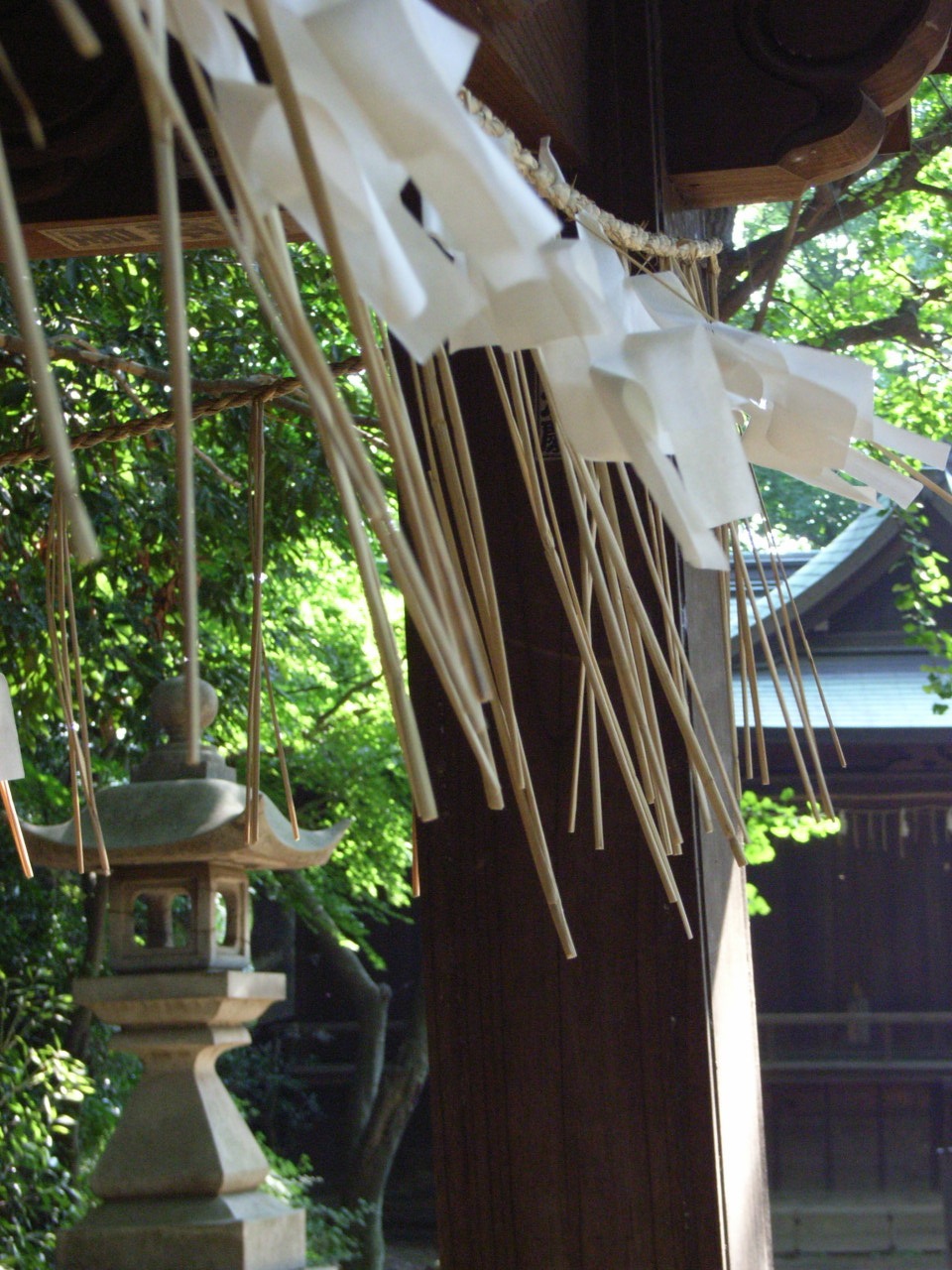
Senzokuike shrine

Rabbit And Grow Fat

About a fortnight ago I went to a cat cafe in Shibuya. It was fun but slightly disappointing that so many of the cats were asleep or just not doing much. Of course, they were cats, what was I expecting? I suppose disdain for the humans so obviously delighted to see them would be par for the course. However, in my efforts to find a cat cafe I also discovered that there were such things as rabbit cafes, and they appealed to me more. There are two in Tokyo; one in Harajuku and one in Jiyugaoka, run by the same people, and so both have the same name: Rabbit And Grow Fat. A stroke of genius, made even more brilliant by the decision to go by the acronym Ra.a.g.f. which can only be pronounced as some kind of roar, and perfected in the cafe’s logo, complete with cartoon rabbit droppings:

Ra.a.g.f. logoAs I have probably mentioned before, I love showing people around Tokyo and the surrounding area. Despite having lived here for more than twenty years I still find myself thrilled with life on a daily basis. I feel incredibly lucky to live in this amazing city, in this great country, and having opportunities to show people around lets me share that, and also to see familiar places through new eyes or just have an excuse to be a tourist myself! The visit to Hapineko (ハピ猫) in Shibuya was such a tourist opportunity, and of course then also a blogging opportunity, but where I was really wanting to go was Rabbit And Grow Fat.

Finally, yesterday, I made it to Ra.a.g.f. in the company of a friend visiting Tokyo. (The same friend who has indulged other odd requests of mine, most notably walking around the whole of the Yamanote Line in a day.) We decided to go to the cafe in Jiyugaoka, since that one is much closer to where I live, but I assume that the one in Harajuku is the same. We had made a failed attempt to go there on Sunday, not realising that you really need to make a reservation, since the cafe is quite small, and they only seem to be able to accommodate about a dozen people at a time. On Sunday we made a reservation for yesterday at 5:30pm, which gave us an extra twenty-four hours to look forward to our rabbity treat.

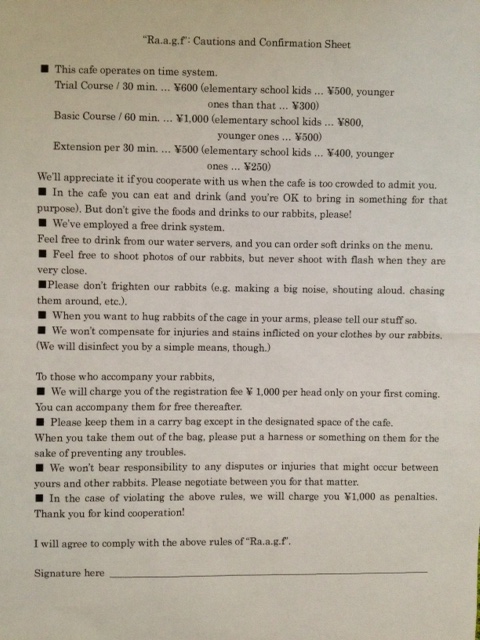
The procedure for gaining admission to Ra.a.g.f. is much simpler than what we had to do at Hapineko, but is really the same kind of thing; take your shoes off, put your bag somewhere out of reach, read and sign a disclaimer:

Ra.a.g.f.rules

choose a drink and then enjoy being with the rabbits. My favourite regulation is the one which states, ‘We won’t compensate you for injuries and stains inflicted on your clothes by our rabbits. (We will disinfect you by a simple means, though.)’ You have been warned!

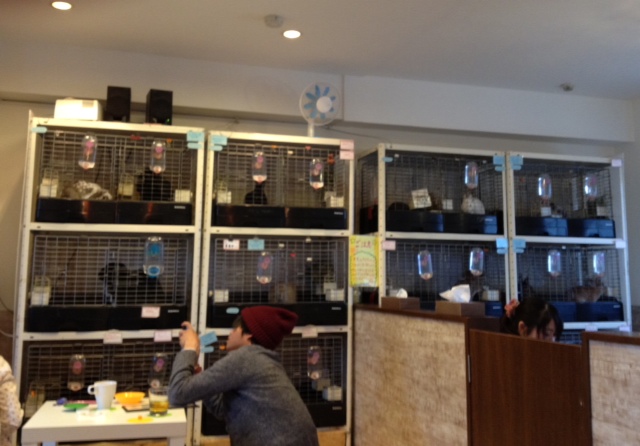
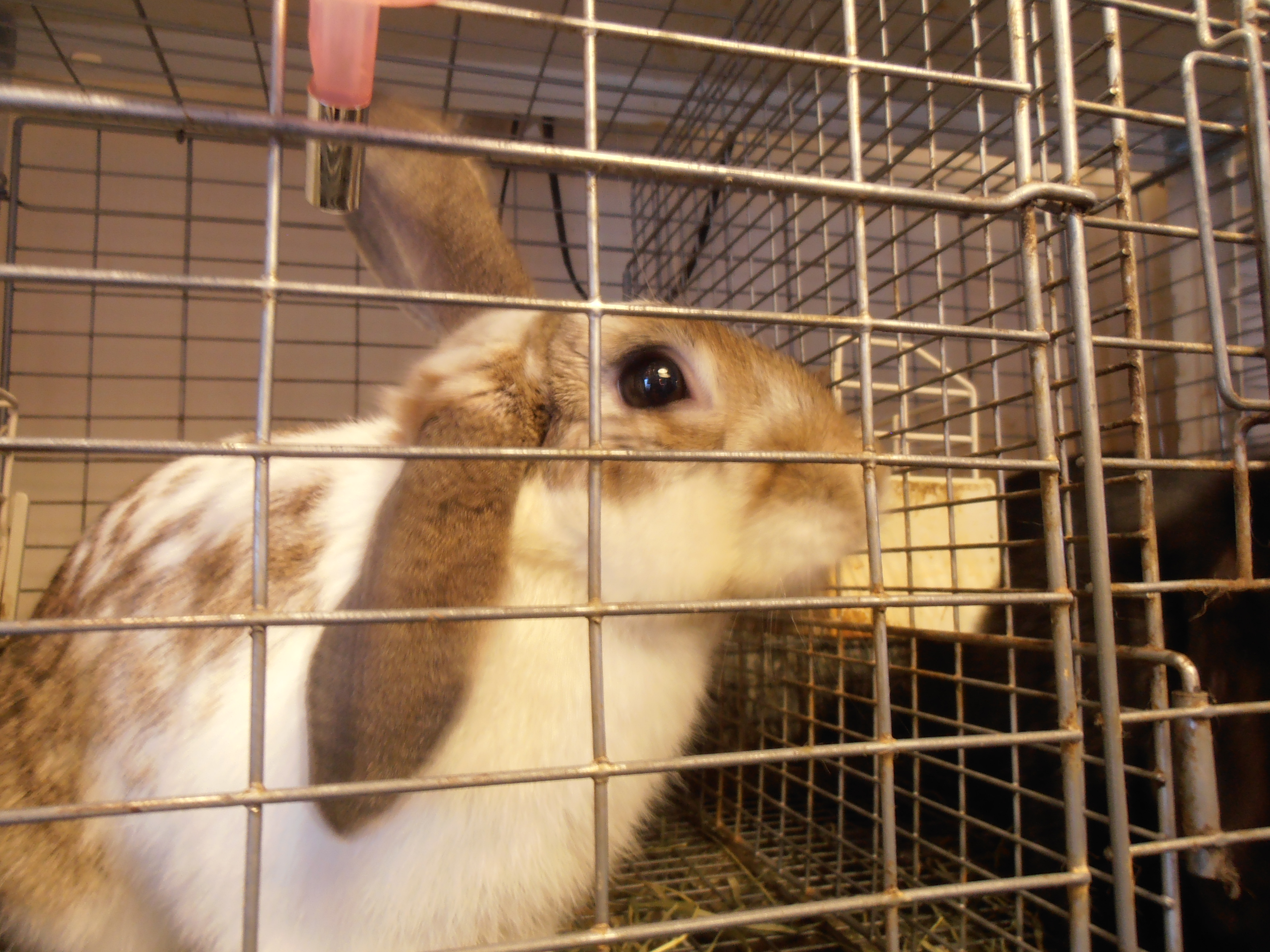
There were two small rabbits hopping about in the cafe, and about twenty in cages at the end of the room.

Ra.a.g.f.2

The room itself is divided by a wall about a metre high, and there was someone sitting inside the smaller part, but I was unclear why he was there. Since it’s possible to bring your own rabbit with you I had thought that maybe that was what he had done, but it became clear that the rabbit hopping around him was one of Ra.a.g.f.’s own, so I have no idea. The young woman working there explained to us that we could open any of the cages and pet the rabbits inside, but we couldn’t take them out. The regulations stated that if we wanted to hold a specific rabbit we should ask the staff, but we were content to pet and feed them in their cages. Maybe next time!

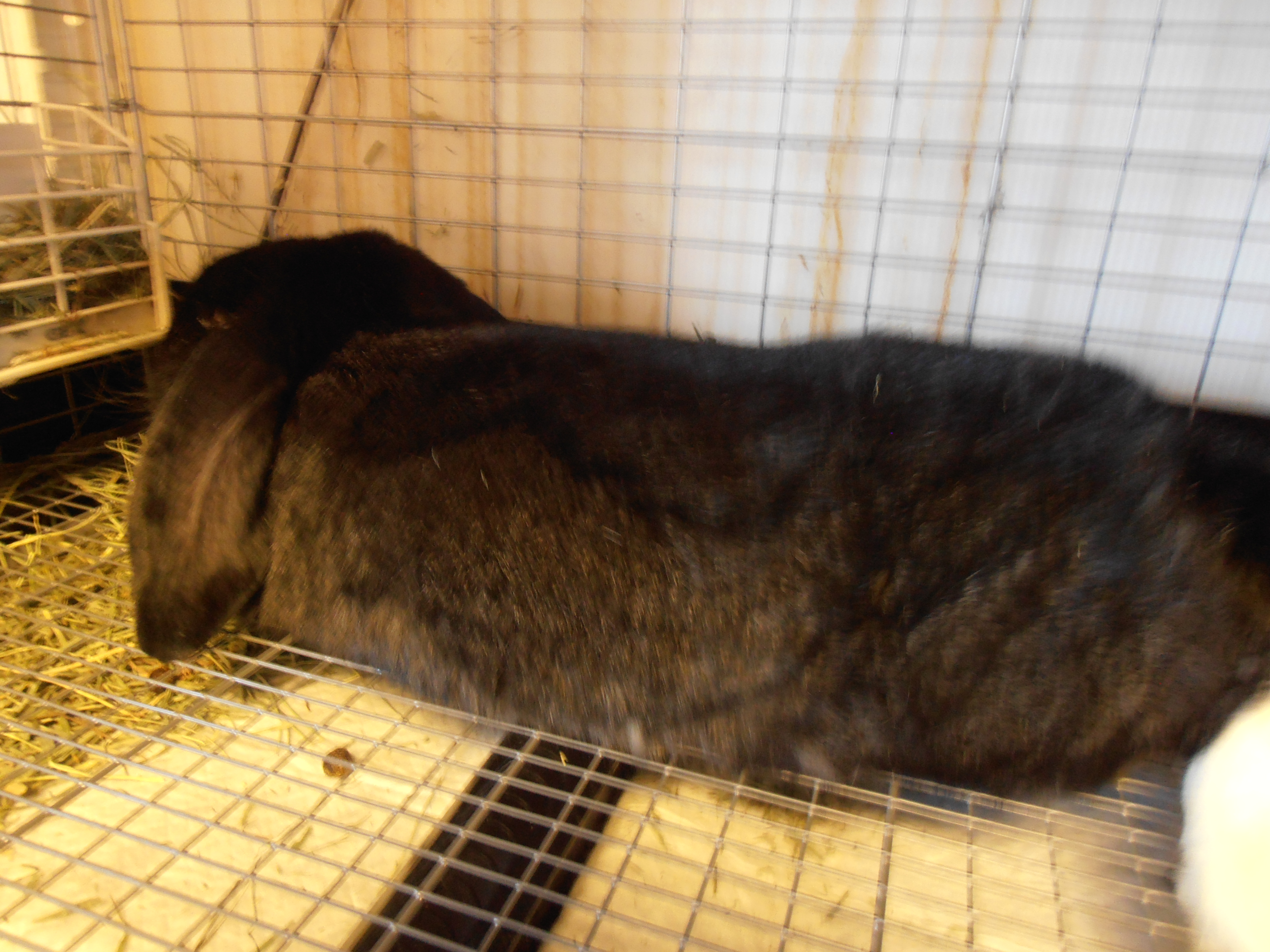
It’s possible to buy a small dish of veggies for ¥100 and we did that. The two small rabbits were extremely lively and rushed around the room stopping for rabbity snacks whenever they were offered, but all the rabbits in the cages were friendly enough to be petted and lively enough and happy to be fed. There is a wide variety of rabbits, the largest being a magnificent specimen called Figaro:

Ra.a.g.f.Figarowho required a cage twice the size of any other rabbit. Other cute rabbits included this little fellow

Ra.a.g.f.6who was very keen to make a dash for freedom, and this one

Ra.a.g.f.7who ate more snacks then any of the others.

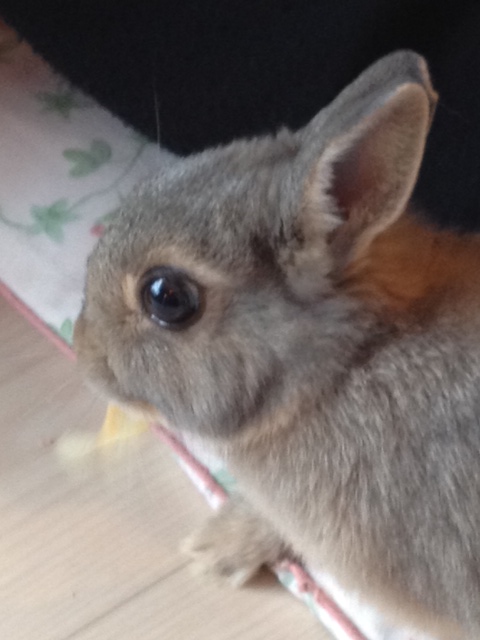
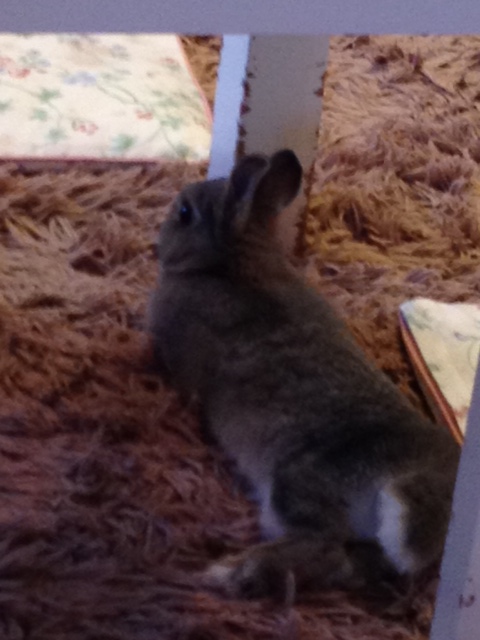
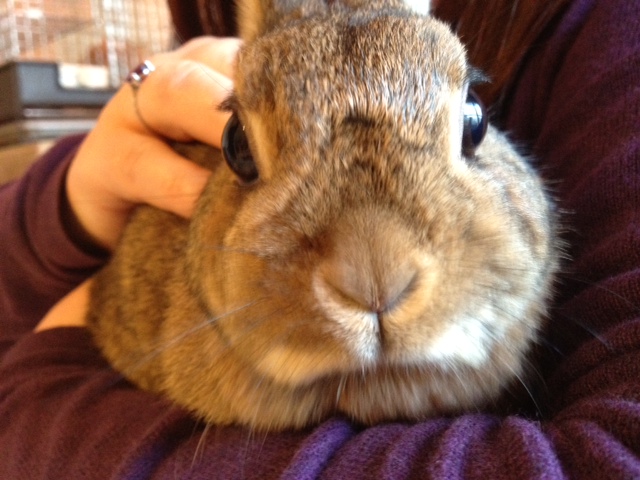
My favourite, though, was Donguri (団栗, Acorn) who was one of the small brown ones. He and his little friend

Ra.a.g.f.1looked just like all the rabbits you can see wild in the UK (I always look out for them when I take a train) but they bounded about and for the most part were happy to be held for a short time. Here is Donguri relaxing under a table

Ra.a.g.f.3and tolerating me holding him

Ra.a.g.f.4We only stayed for half an hour, which is the ‘trial course’, and costs ¥600, and includes one drink. The regular course is for one hour, and costs ¥1,000. The information says that they have a ‘free drink system’ so you may be able to order more than one drink in that case. If you want to spend longer than an hour, you can extend by thirty-minute increments, for ¥500.

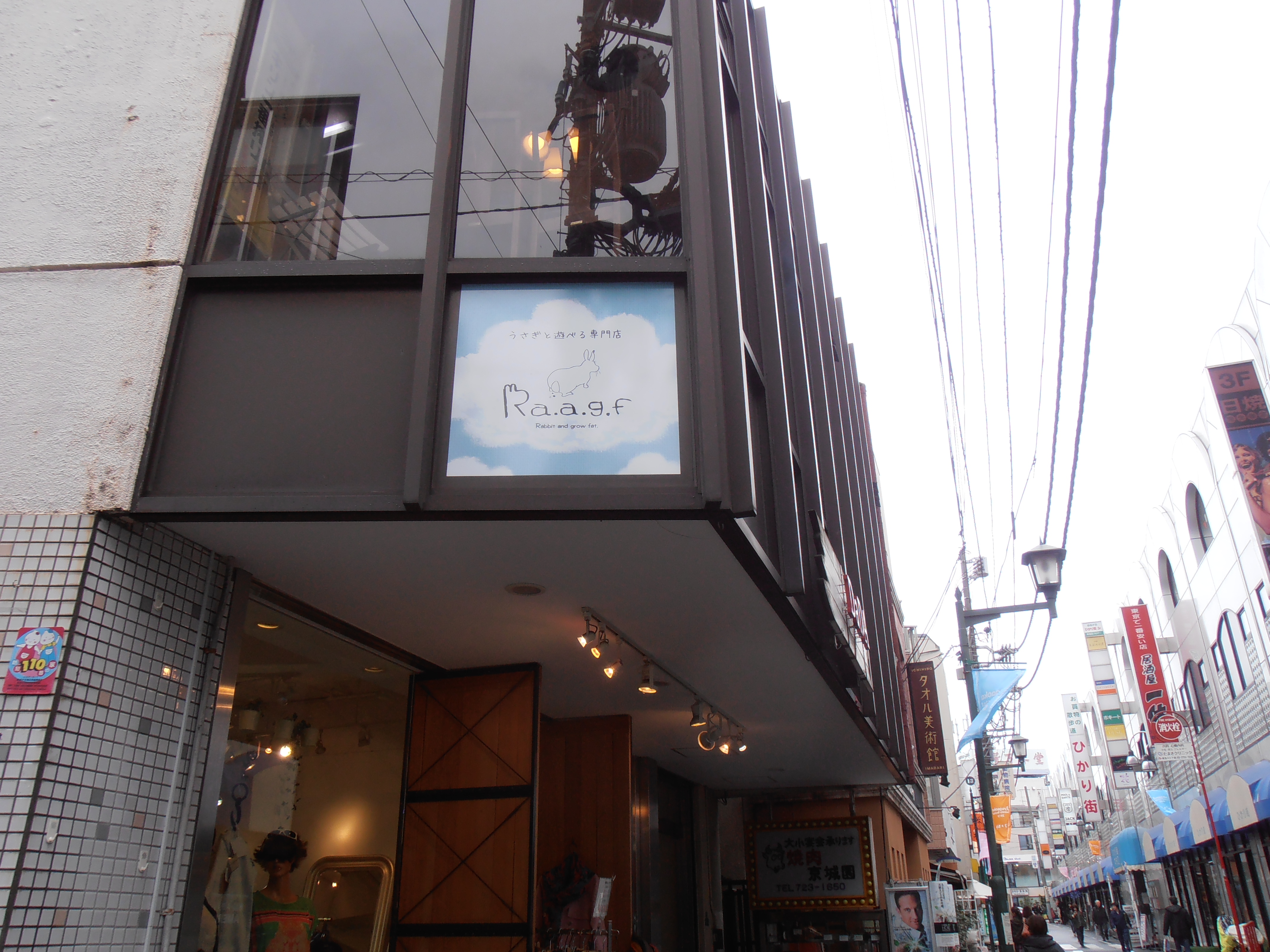
I really enjoyed Rabbit And Grow Fat, and since it’s so close to home I’m tempted to go sometimes, and certainly anyone coming to visit me will be taken there. I’d also like to go to the branch in Harajuku and see how similar it is. If you’d like to go to Ra.a.g.f. Jiyugaoka, it’s very easy to find. From the main exit of the station, turn right and walk along the road beside the old (but recently renovated) Jiyugaoka Department Store. Ra.a.g.f. is on the corner at the second turning on the left. You can see the sign on the corner of the building:

Ra.a.g.f.outsideand the cafe itself is on the fifth floor.

I found the whole experience relaxing, and fun in a very only-in-Tokyo- kind of way. As a novelty for someone visiting Tokyo it’s perfect, but even if you’ve lived here for a long time, it’s worth a try. Let me know if you’d like company!